The joints of a body are where its strengths and weaknesses sit. They are the points where things are articulated meaning they can move and adapt to dissipate stress. But they are also sites of vulnerability where splits, fissures, ruptures, and separations happen. Jan McCullough’s handsome show I Took a Hammer in My Hand can be seen as a meditation on joints from a photographer’s gaze. It looks at junctures rather than boundaries between various assemblies, be they anatomical, infrastructural, or bodies politic, and invites us to work out how things fit or sit together.
For those of us, me included, who are neither practically minded or adroit, there is a certain kind of magic to things that are made well. I Took a Hammer in My Hand captures this magic. Yet while there are allusions to utility and practicality, there is nothing so blunt as being merely useful. There is beauty here.

Jan McCullough, I Took a Hammer in My Hand, installation view, Butler Gallery, 2026. Photo: Ros Kavanagh. Courtesy of the artist & Butler Gallery.
The exhibition fills a modest room at the Butler Gallery with objects and photographs referencing carpentry. The assemblages of Off Cut (2026) are three-dimensional arrangements of various derivations of wood, including raw deal, maple, plywood, veneers, and MDF in the muted colours of unvarnished and unpainted timber. They are reminiscent of the detritus found in workshops, produced from manufacturing processes that slough off curls of shavings, odd bits of material, sawdust and whatnot. Flush against the wall is a low stack of short-cut untreated wooden beams with a line, squiggle, and cross formed in aluminium alloy sitting atop. None of these objects are representational, figurative, or, to my eyes, symbolic but are rather evocative of the shapes and strategies of craftwork presented at different scales. As a result, it’s tempting to regard the assemblages as adjacent to rather than embodying sculpture. The benefit of this lies in keeping them tethered to the workshop rather than isolating them in the hygienic space of an art gallery and linking them into the accompanying histories and debates. This linkage means that these things might still be able to do things in the real world rather than merely bear witness to it. The effect of such potential usage is emphasised by the hanging dyed cloth that divides and articulates the space with the character of a drop cloth protecting things from the dust and drips of practical work.

Jan McCullough, I Took a Hammer in My Hand, installation view, Butler Gallery, 2026. Photo: Ros Kavanagh. Courtesy of the artist & Butler Gallery.
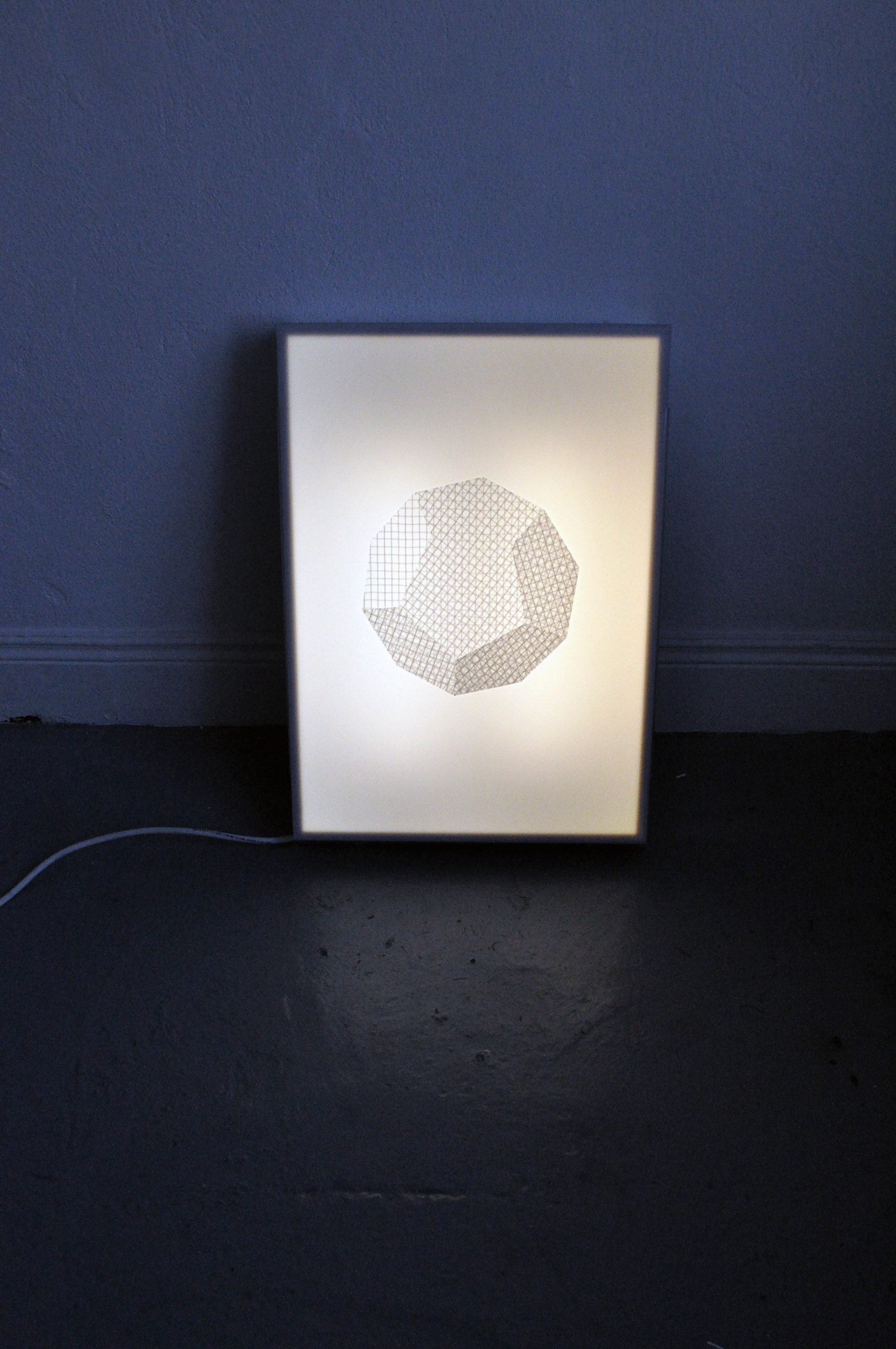
The photographs of Maquette (2025–26) document handmade models for wooden roofs made by unknown apprentice carpenters working across Ireland. In their staging, glimpses of the workshops in which they were made remain visible, reminding us that these are provisional rehearsals for larger-scale constructions. They are the outcome of standard training exercises encouraging apprentices to develop their fabrication skills through the practice of translating two-dimensional plans into three-dimensional samples. The photographs reverse this process and mediate the objects back into intricate patterns of lines. The models are the ones that were left behind by now anonymous apprentices. The title Maquette alludes to the work that is to follow. These objects are only the prototypes and starting points for the work that is to come next, outside of the experimental spaces of workshops. They are the embodiment of careful speculation on forms-to-come. If such forms are immanent then they lie dormant in the things (the wood, relations, histories, techniques) that are waiting to be joined and deployed. And it is here we find the immanent politics that McCullough allows us to witness. It is a reminder that if we need something done, then we might have to do it ourselves
The exhibition title is taken from Florence Adams’s DIY manual I Took a Hammer in My Hand: The Women’s Build-It and Fix-It Handbook (1973) in McCullough’s collection. It contains detailed pictures and advice for readers looking to conduct their own repairs at home. McCullough has explained that Adams wanted to promote a process of ‘learning through looking’. Such an approach, through being adjacent to language and hence metaphor, is non-didactic; it shows rather than tells. It has an elective affinity with McCullough’s own approach as a photographer who has a particular way of looking at the world through the apparatus of the camera.

11 Talbot’s Inch, 2026 & Aut Even (Garden Entrance View) Talbot’s Inch, 2025. Photo: Ros Kavanagh. Courtesy of the artist.
There is, in McCullough’s words, ‘a strangeness that the photographic gaze gives’. Photography arrests things as they sit together in particular configurations that might be easily overlooked and presents them for reflection. In this case the objects are unattributed and uncoupled from particular makers: the camera isolates specific details, especially their vertices. The camera is also a mechanism that gives access to people and spaces. With a camera as an apparently dispassionate and non-judgemental research device, and hence calling card, McCullough was allowed into studios to see the provisional, unfinished, and speculative work of people practising in advance of future industry.
No exhibition is individually achieved; teams of people and objects are always involved. However, this one makes specific meeting points its conceptual and aesthetic theme and reveals how it is the outcome of research and collaboration in very particular times and places. For this iteration (it will be travelling), two of the photographed roof models are based on the distinctive roofs and architecture of Talbot’s Inch, an historical model village in Kilkenny built by and for workers and craftspeople from the local area. The work was also informed by many conversations with carpenters and former apprentices who reflected on their practices and the forms and techniques they work with. The sculptural objects were made with Waterford-based furniture maker David Carpendale, and their relationship to useful objects perhaps explains how they hold in check an exquisite balance between elements that are solid, internally coherent, and apparently self-assured while also appearing provisional, contingent, and likely to change soon.
A certain type of philosopher is keen to invoke Plato and claim that a certain type of philosophy, like scientific observation, is about carving nature at its joints. McCullough is doing something else but no less philosophical. She’s not carving but re-assembling different joints where different things meet and pivot in open and dialectical relationships. Such dialectics might hinge around a number of joints between pairs including:
Image / object;
two-dimensions/ three-dimensions;
amateur / professional; art / not art;
passive / active;
useless / useful;
human / nonhuman;
straight / bent;
fixed / fluid;
tag normal / queer
Such thinking in terms of joints is more generative than working with edges and limits. It invites alliances and partnerships between things and people and suggests a new form of Constructivism for our uncertain and precarious times.
Francis Halsall is a lecturer in Visual Culture at the National College for Art and Design, Dublin, where he is co-director of the Master’s programme Art in the Contemporary World.
This review was originally published in PVA 17 – the fashion issue. Purchase your copy here.