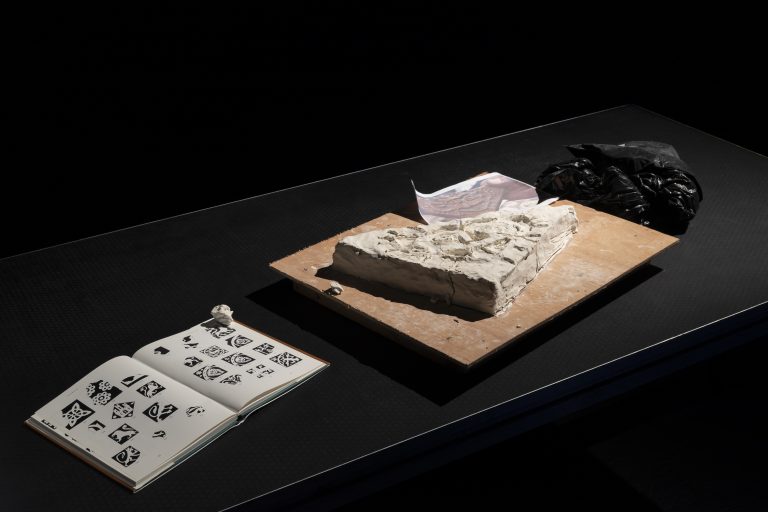
The English painter Phillip Allen is known for combining pictorial imagery with densely worked, heavily textured surfaces. His signature device – legible across all twelve of the paintings included in his recent exhibition at the Kerlin Gallery, Deep Waiting – is his use of thick impasto at the edges of the canvas. These multi-coloured accretions function like a frame, encasing the pictorial plane at its centre. Many metaphors have been used to describe them: ‘thickets’, ‘cake frosting’, ‘clots of dirty gum’, ‘blossoms’. To my eye, they resemble chewed-up wads of tissue paper. Whatever your preferred allusion, these globular paint-clumps typically surround a central abstract image, executed in a colourful geometric style.
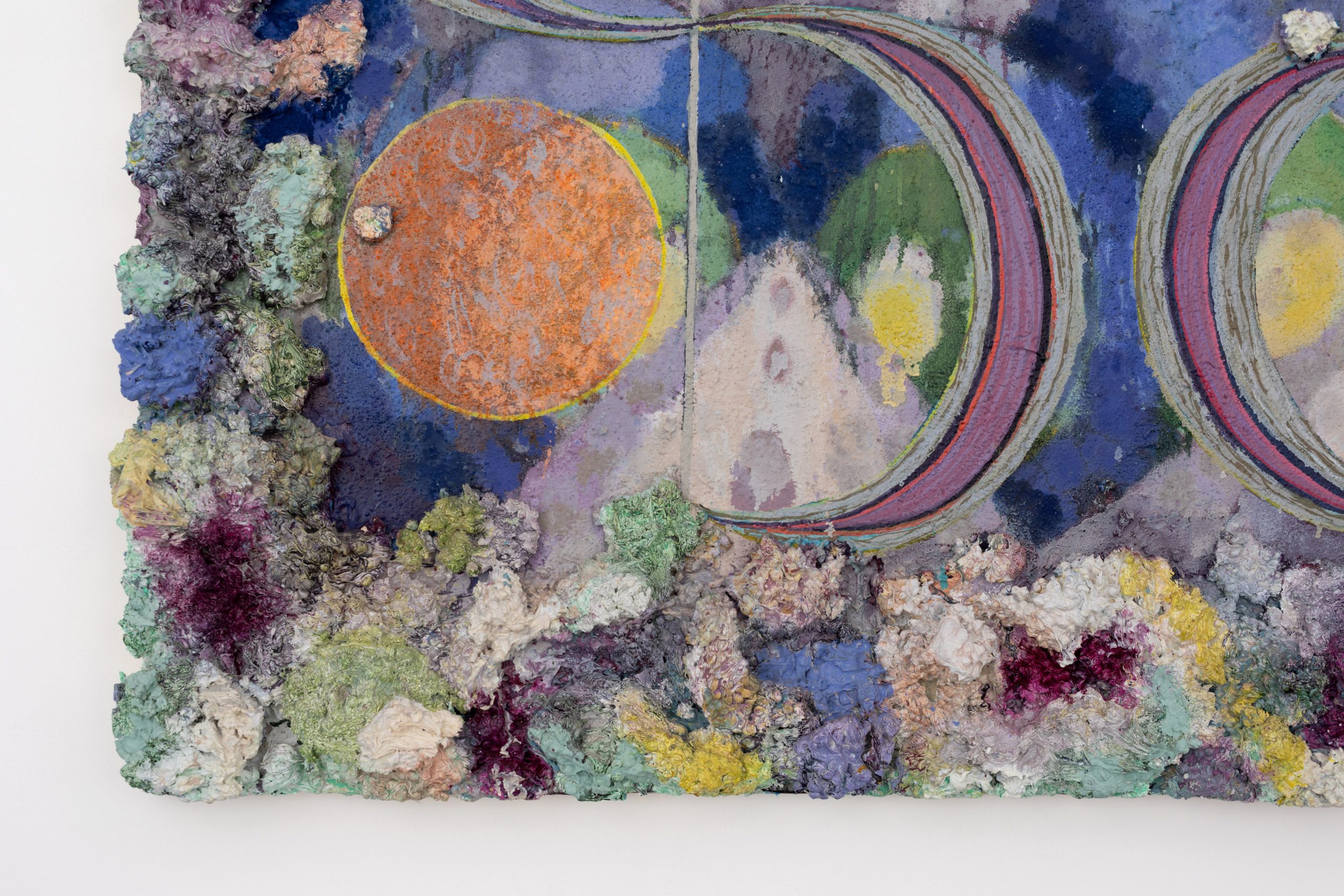
Phillip Allen, Flat Space Thinking (Addictive shape formation), 2025, oil on board, 135 × 12 cm. Courtesy of Kerlin Gallery.
Colour, indeed, is front and centre: his paintings are saturated with rich hues, spanning from bubble-gum pink to cobalt, emerald, and cinnabar. In a piece like low memory (wet edge version) (all works 2025), Allen employs contrast to striking effect, setting green against red and blue against blood-soaked orange, while also pitching warm colours against cool. These contrasts generate a restless push–pull across the surface of his paintings, creating a feeling of turbulence that seductively pulverises the eye – stitching the paintings together only to pull them apart again.
Conversely, Allen’s abstract figuration recurs and builds into a kind of consistent formalised iconography. In several paintings, a symmetrical design of crescents and orbs is repeated, accumulating a symbolic charge. Casting your eye across these works, you can’t help but suspect that these designs are cryptograms or ciphers, capable of revealing some esoteric truth to its chosen initiates – like postcards from the occult.
Over the past decade and a half, Allen’s work has been the subject of a sizeable body of criticism. Critics have approached the work from different angles, but their interpretations tend to converge around two key themes.
The first and most significant cluster of critical ideas can be gathered under the heading of materiality. As I’ve mentioned, the formalist dynamic that makes Allen’s style instantly recognisable is the interplay between chunky medium and representation; or between paint as denuded material, and paint as a means to imitate. This, of course, is a familiar tension, traceable to the twentieth century’s modernist turn. For theorists like Clement Greenberg, ‘avant-garde painting’ unfolded as a history of ‘progressive surrender’ to the resistance of paint, a resistance grounded in the flat picture plane’s denial of efforts to ‘hole through’ it for realistic perspectival space. [1]
Throughout his career and in different guises, Allen has made work that revisits this modernist tension, deliberately forcing frameworks of representation and materiality into fraught relationships. His work enmeshes the duality of painting’s material and pictorial possibilities in an ever more intensive reciprocity: medium resisting perspective, surfaces vying with forms, the objecthood of his artworks competing with their own graphic illusions of depth.
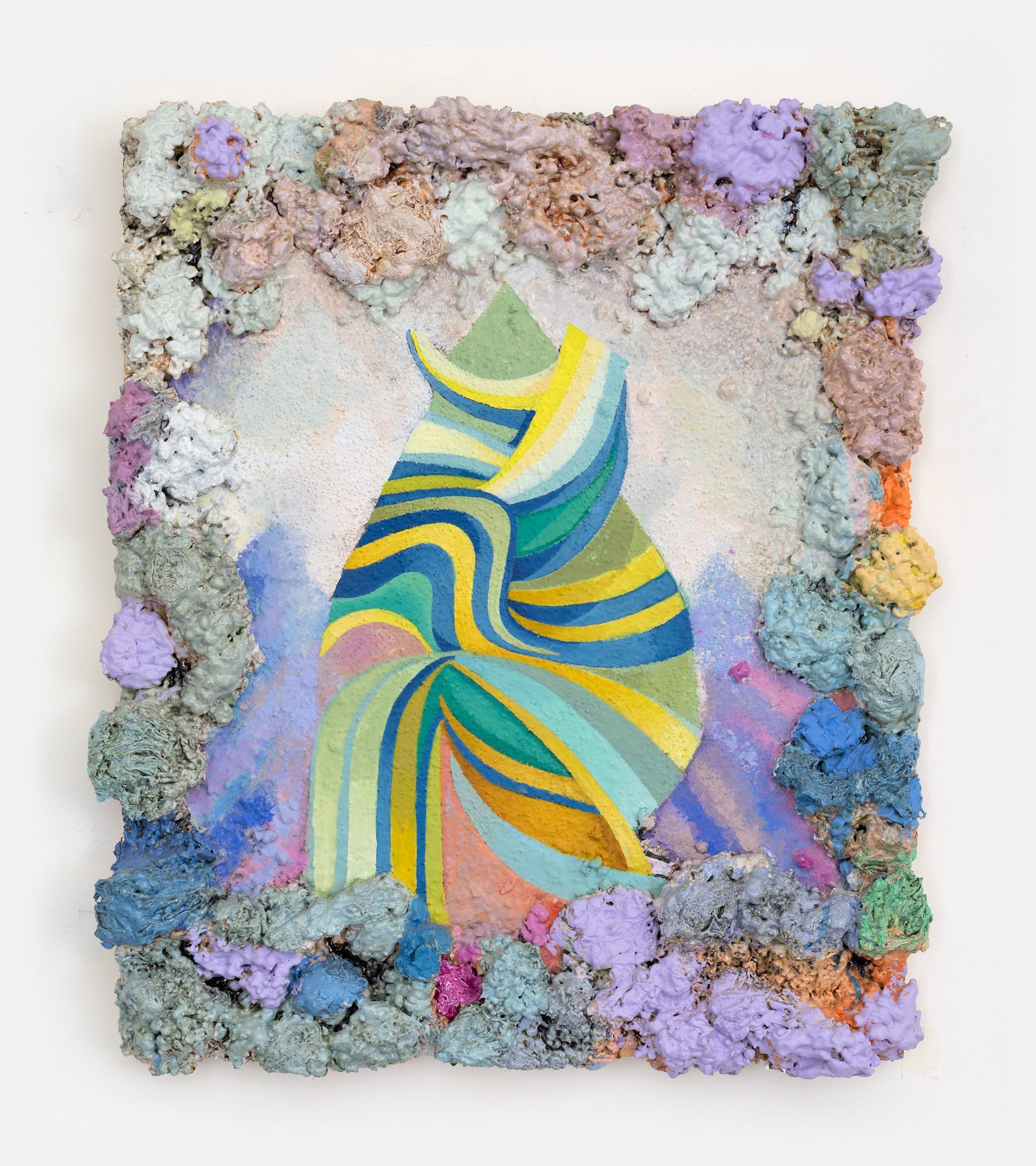
Phillip Allen, Object wants (wet edge gambit), 2025, oil on board, 65 × 55 cm. Courtesy of Kerlin Gallery.
The second cluster of critical ideas bears on waste and entropy. Allen’s impasto mounds resemble a by-product of the artistic process, like excess paint scraped from a brush, or messily squeezed from a tube. Critics have read this aspect of the work in different ways. For John Yau, a longtime advocate of Allen’s at Hyperallergic, it establishes a circular logic, where what might otherwise seem incidental or superfluous to the act of painting becomes a constitutive feature. According to Declan Long, on the other hand, Allen’s technique reminds us of noise, sludge, and dissolution, leading to an extraordinary intensity that is best understood as a visual parallel to contemporary informational overload: dizzying distractions warp our perception, ‘sending our eyes in dozens of directions at once.’ [2]
Across their different emphases, Yau and Long converge on a shared theme of aesthetic decay. In pre-modern aesthetics, ugliness and its satellites (decay, dissonance, fragmentation, waste, entropy, etc.) had no proper place. Even the father of modern philosophy, Immanuel Kant, excluded ugliness from his work on aesthetics: Kantian purveyors of ‘pure taste’ were concerned exclusively with the beautiful and the sublime. However, later thinkers, immersed in the cacophony of modernism, needed to stoop lower and get their hands dirty. For the likes of Nietzsche and Adorno, dissonance becomes a productive force: Dionysian energies for the former, and for the latter, truth-containing responses to a damaged modern world.
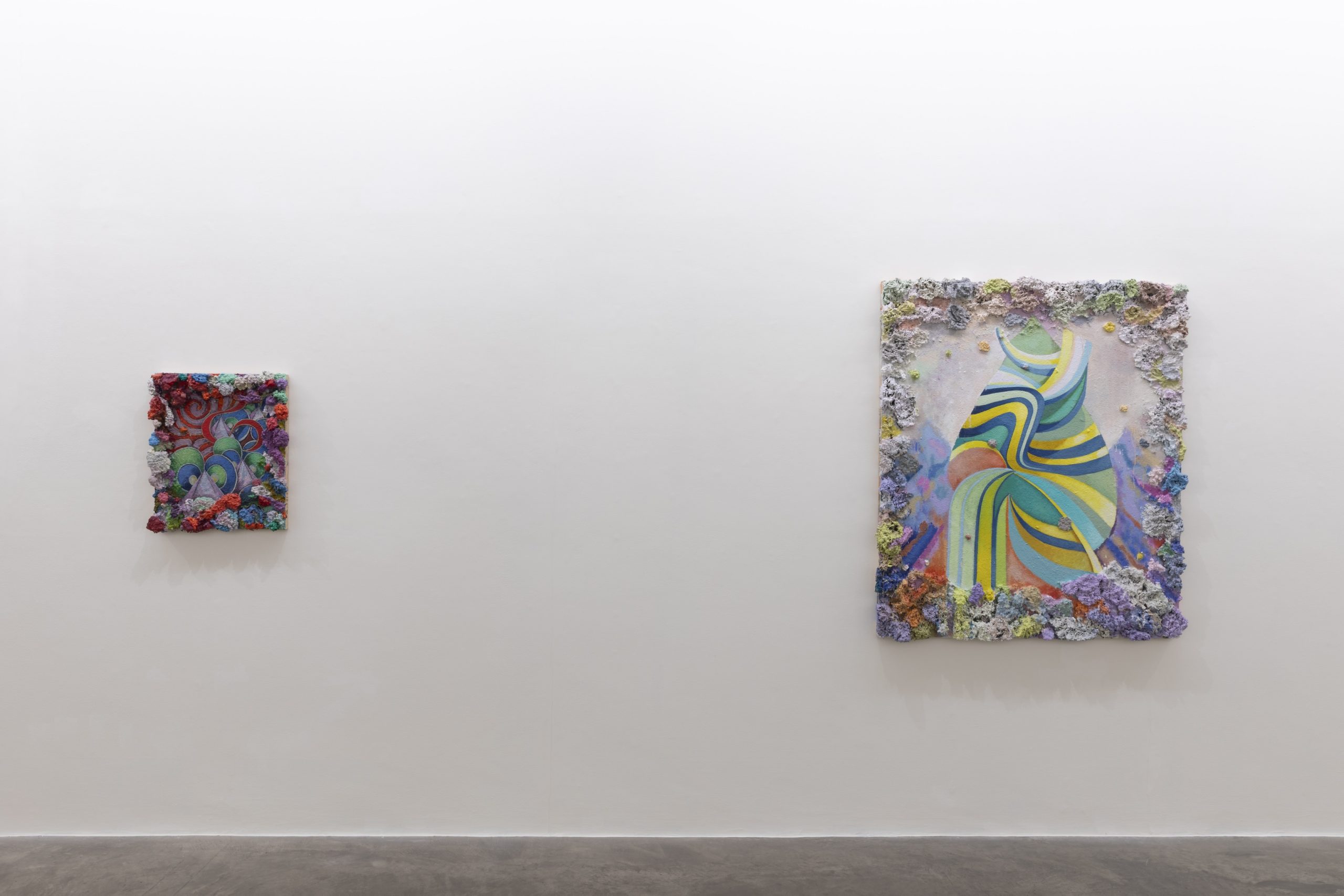
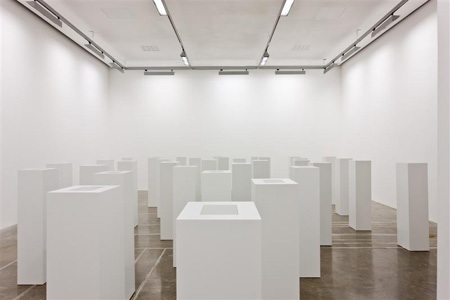
Phillip Allen, Deep Waiting, installation view, Kerlin Gallery. Courtesy of Kerlin Gallery.
As soon as one starts to extrapolate the relevance of materiality and aesthetic decay, focus is drawn to the beginnings of modern art. This is not a coincidence: across the years, Yau has frequently noted that the English painter’s knowledge of modernism is ‘encyclopaedic,’ and Allen himself acknowledges the pleasure he takes in grappling with art’s intellectual heritage: ‘The thing that I enjoy the most is the intellectual challenge of how to make a blank surface interesting. This is not so simple a task as it incorporates so much other stuff and exposes you to a world of deep thinking by others.’ [3]
In Deep Waiting, the artist continues to explore the formal and intellectual heritage of contemporary painting. However, while materiality and aesthetic decay make their presence felt, my eye was attuned to another modernist tension in the work: one less to do with density or decay than with distance.
At close range, the distinction between Allen’s heavy impasto borders and the central geometric form is pronounced, even severe. At a distance, however, this distinction loses traction and unity settles into the work: the painting resolves into a single field. How does this happen? At a remove, the central image exerts an optical influence on the impasto mounds, guiding the mind to fill in what the eye loses, and imposing a consistency at the level of material texture. Take a painting like are we guests (stubbed motif version), which is one of the larger works in the exhibition. From afar, the central form coheres into something like a surrealist landscape: winding paths linking a sequence of hills; blue and green archways framing a golden sphere, suggestive of light filtered through glass apertures. Offset by the clean triangular constructions marching across the bottom, the majority of its forms are hazily composed: Allen’s oil paint has a watercolour-feel, soft and fluffy at the edges. This quasi-bucolic scene infiltrates the surrounding clumps, and they appear almost porous, suggesting the structure of sheep’s wool, sponge, or moss – evoking absorbent and organic qualities.
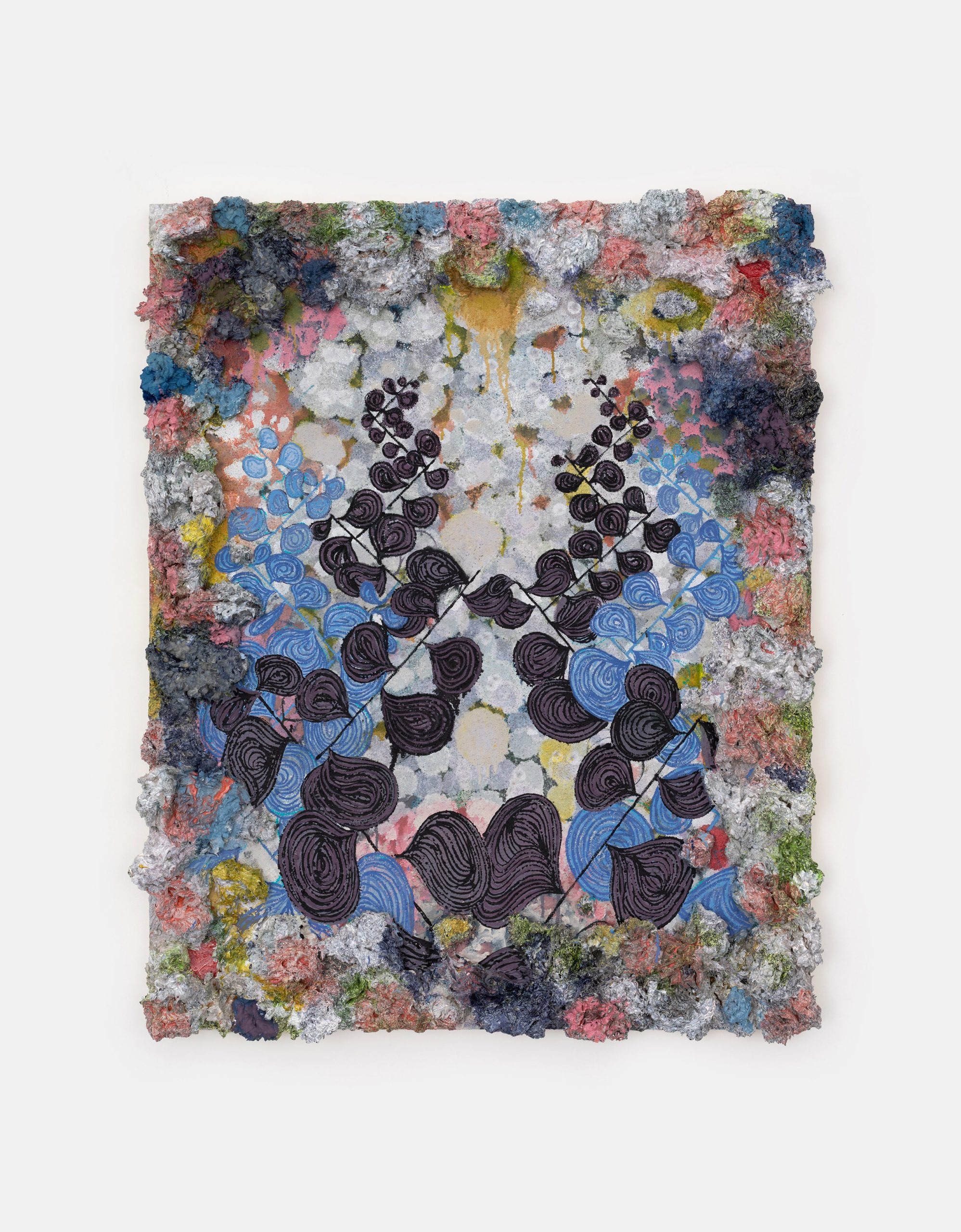
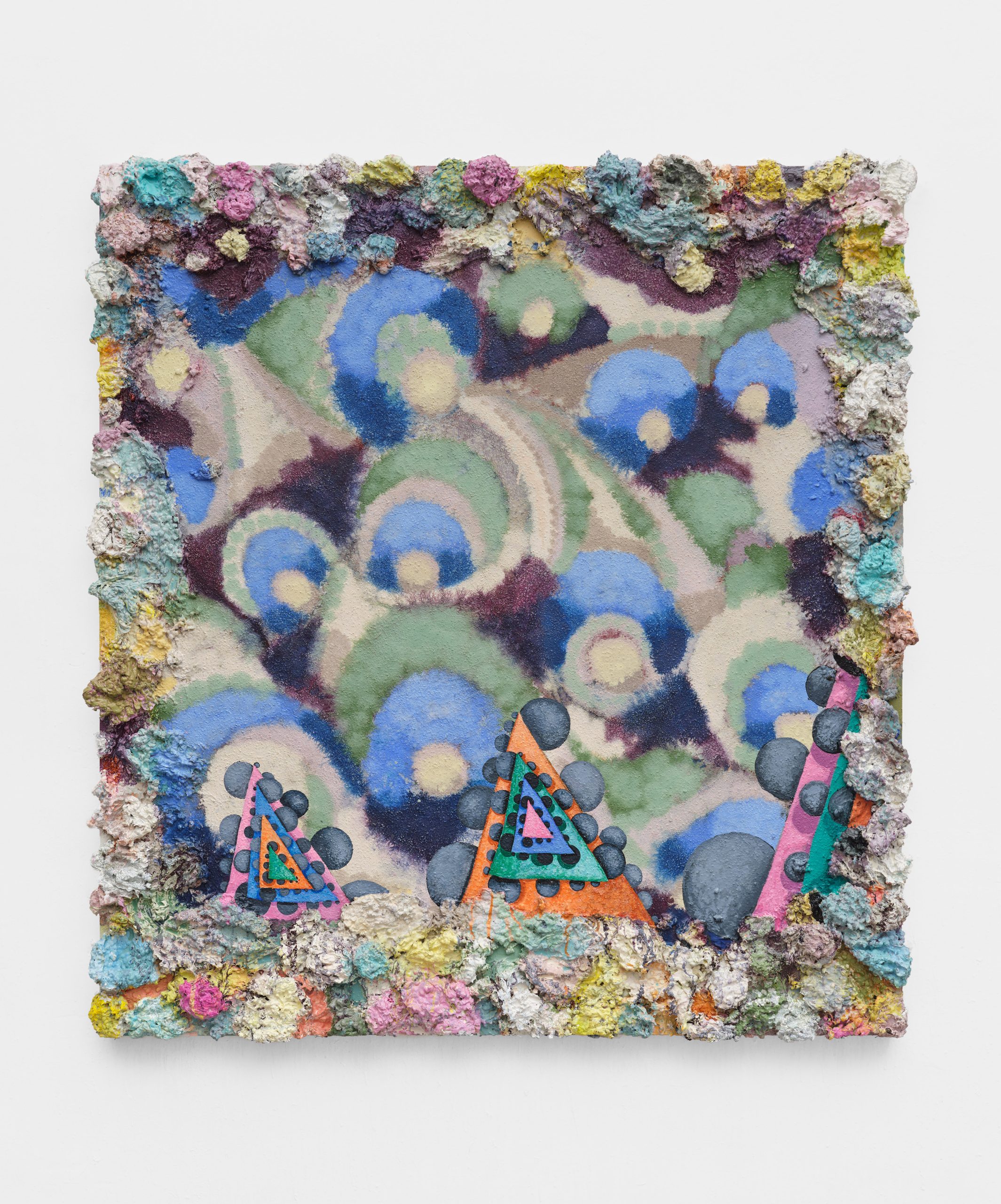
Phillip Allen, The So Called (Studio Version), 2025, oil on board, 105 × 85 × 9 cm. Courtesy of Kerlin Gallery.
A similar optical effect is visible in two other paintings, compulsion loops (wet edge version) and The So Called (Studio Version). In both, Allen employs a scalloping motif that brings to mind coastal environs, though here his colour palette keeps the spectre of landscape at bay, planting us firmly in hallucination and dream. In these works, the impasto takes on a rugged marine appearance, coral-like, the individual clumps now reminiscent of bright, nutrient-rich algae formations.
Close up, however, the suggestion of a natural relationship between frame and central image dissolves. The textures lose their pleasing consistency. Gritty and granular, the surfaces feel less vegetal than chemical. The nodules of paint look like coarse mixtures of construction-site materials: sand, epoxy, and plaster. Not so much sponge, as stained cement. A roughness comes to the fore, and it is this abrasive grain that, revealed through proximity, intensifies the works’ pallor of dissolution and decay. One visitor to the exhibition described the paintings, at close range, as ‘repellent’ (and not as a criticism).
This uneasy relationship to observational distance calls to mind early critical reactions to the Impressionists, whose landmark 1874 exhibition, featuring works by Cézanne, Monet, Pissarro, and so forth, was excoriated on precisely these grounds: fine from far away; close up … not so much. Louis Leroy, taking aim at Monet’s groundbreaking Impression, Sunset (which unwittingly gave the movement their name) wrote: ‘Wallpaper in its embryonic state is more finished than that seascape.’
What Leroy’s critique unconsciously registers is that the minimalist economy of the Impressionist paintings revealed something new: their brushstrokes did not simply construct a scene, but called attention to the medium through which the scene was made visible. The Impressionists’ canvases heralded an interest in materiality, in pure medium, a transformation that would flower across Europe in the twentieth century. Allen offers an opportunity to re-experience this troublesome relationship – his paintings at the Kerlin seduce from afar in order to activate their principal critical concepts via proximity.
And by placing observational distance under scrutiny again, Allen finds a way to raise a series of basic but fundamental questions: where should one stand? From what vantage point does the work come into view? How does the work position, or interpolate, the viewer? Is there one ‘true’ work and, therefore, one true position? In the contemporary moment, as the internet spreads its contagion of mental rigor mortis, hardening opinion into rigid categories, these feel like ever-more pressing questions.
Tom Lordan is a writer based in Dublin.
Notes
[1] Clement Greenberg, ‘Towards a Newer Laocoon’, in The Collected Essays and Criticism, vol. 1: Perceptions and Judgements, 1939–1944 (Chicago: University of Chicago Press, 1988), 34.
[2] Declan Long, ‘Phillip Allen,’ Artforum, vol. 55, no. 9, May 2017, https://www.artforum.com/events/phillip-allen-5-230193/.
[3] Penny McCormick, ‘Artistic License: Deep Waiting with Phillip Allen,’ The Gloss, accessed March 6, 2026, https://thegloss.ie/artistic-license-deep-thinking-with-phillip-allen/.