In a recent episode of the Dialogues podcast, curator Helen Molesworth, Dia Art Foundation curator Donna De Salvo, and artist Amy Sillman discuss what Molesworth describes as ‘the brass tacks of the how and the why of installing art exhibitions’.[1] Towards the end, in response to DeSalvo’s description of hanging a Warhol show to make a particular argument about his work, Sillman makes the point that, as an artist curating an exhibition, she doesn’t have a truth claim to uphold. She describes her motivation, not in terms of making an argument, but in terms of generating ‘pure visual surprise’. This tension between the requirements and affordances of art practice and those of academia has played out in Fiona Marron’s rich body of work over the past decade and a half or so. Marron has always displayed the curiosity and tenacity that serve as cornerstones in the most inventive academic research, but her long-standing engagement with communication and internet infrastructures foregoes academia’s rhetorical requirements. Instead, through precise strategies of selection, juxtaposition, and reconfiguration, she creates a space of encounter with infrastructural situations and artefacts, that are, at once, everyday and weird.
In Marron’s recent exhibition at Pallas Projects/Studios, The centrality of bodies, her kinship with academia is most explicit in her collaboration with Jane Ruffino, a researcher currently pursuing a PhD on the contemporary archaeology of the undersea fibre-optic cable network. As a UX architect and archaeologist, Ruffino deals with both the construction and the reconstruction of sociotechnical systems. An A4 sheet that accompanies the exhibition pamphlet reproduces a short text by Ruffino on one side and Marron’s black-and-white image titled Grappling Rope (2025–26) on the other. The text gathers participant-observer style notebook entries that focus on bodily encounters with the materiality of network technologies. In vividly describing the kind of knowing that comes from doing, Ruffino refers explicitly and tangentially to some of the contexts explored in Marron’s artworks. Her text acts as a useful foil to the exhibition, eschewing the academic tendency to claim a position of expertise. Instead, her writing gently informs and contextualises the work. As in art practice, speculation plays an important role in archaeologists’ engagement with visual artefacts, and Ruffino’s text parallels the work, in the sense that they both enact a process of bringing knowledge into being.
Fiona Marron, The centrality of bodies, 2026, installation view, Pallas Projects/Studios. Photo: Serhii Shapoval. Courtesy of the artist and Pallas Projects/Studios.
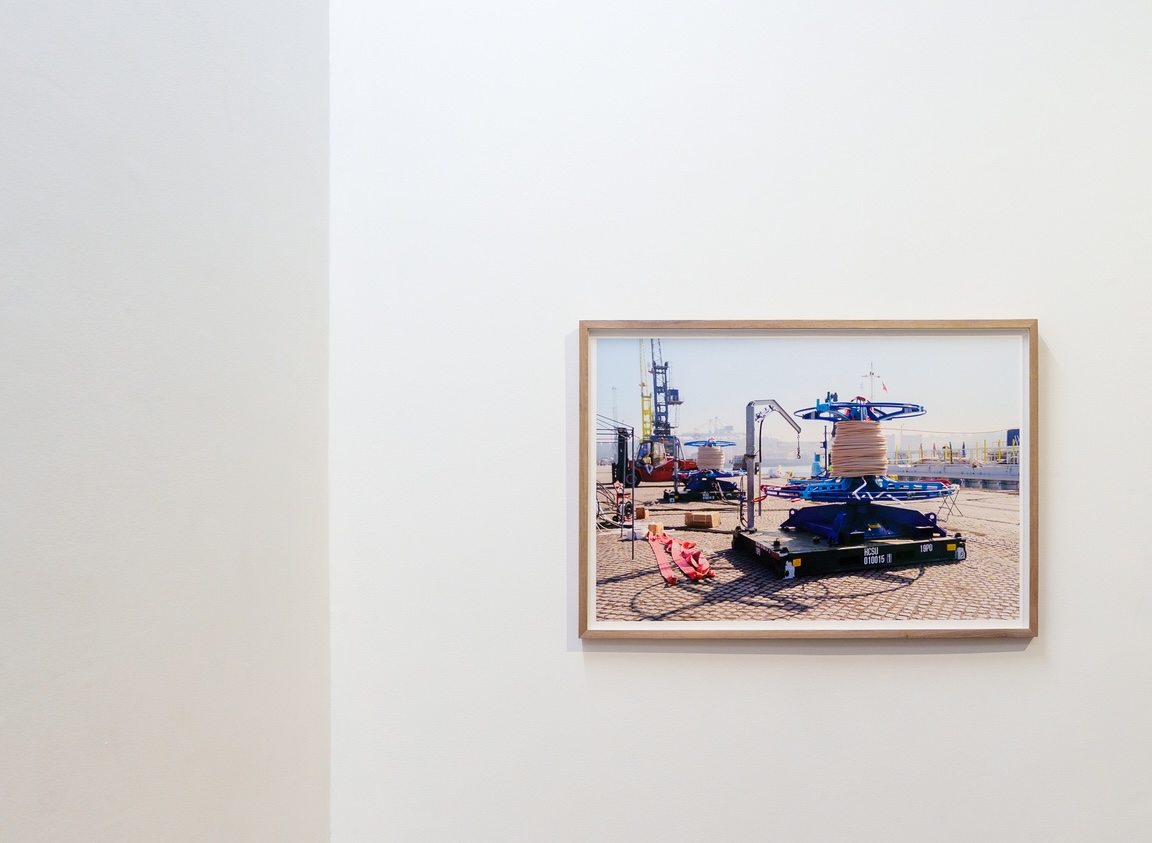
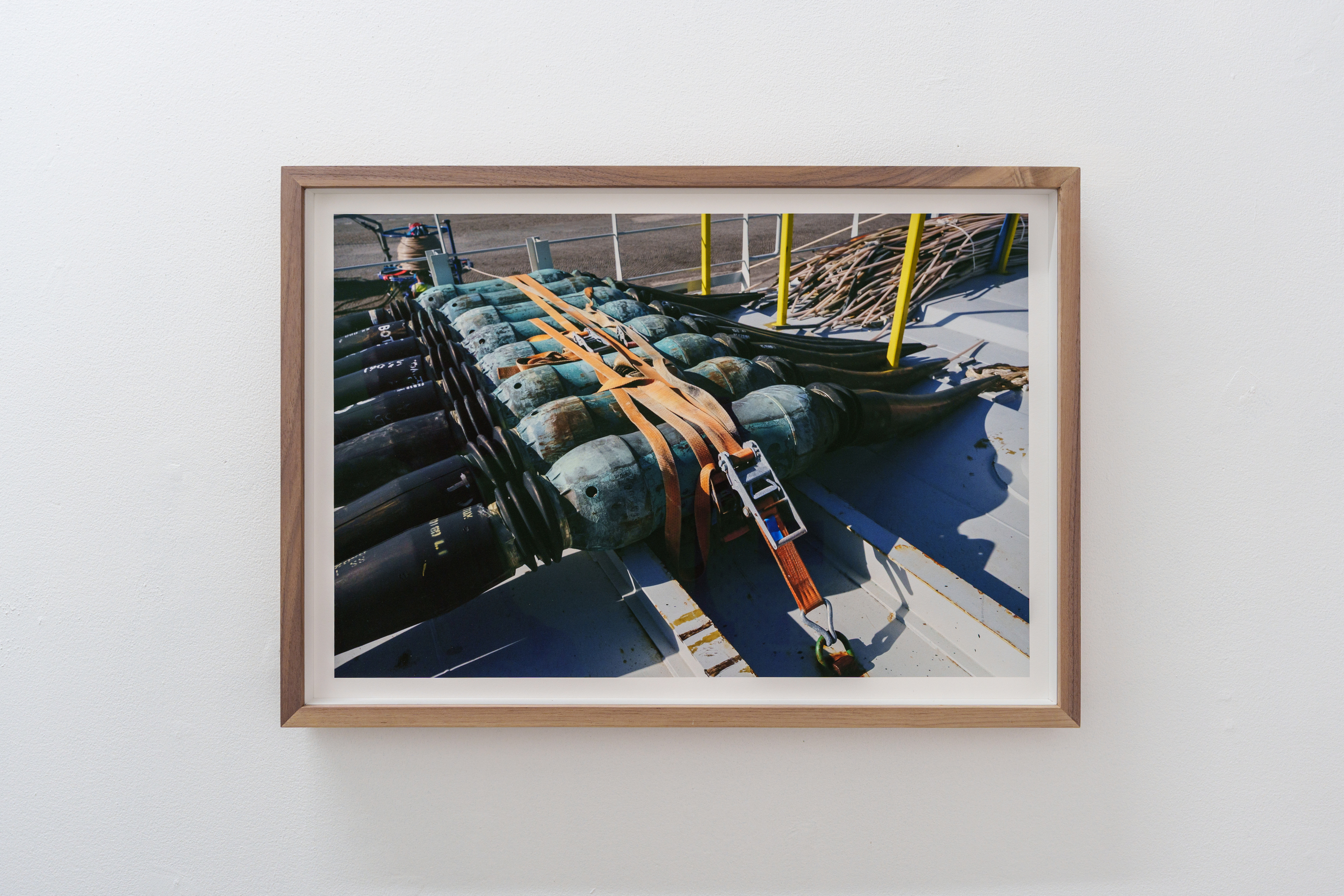
The gallery space itself is modest but cleverly structured. Two partition walls divide a medium-sized rectangular room into two squarish spaces and a short corridor. For The centrality of bodies, the two larger spaces are predominantly occupied by noisy, active video works, while groups of framed photographs detailing specific elements and scenarios that surface in the videos are mostly clustered in and around the corridor space. The most striking of these images captures a collection of opto-electrical-opto repeaters, or regenerators, ratchet-strapped to the deck of the ship like some kind of extraterrestrial cargo. If one was to argue for the existence of infrastructural aesthetics, their unheimlich extruded form might serve as a useful example. These network components were developed to amplify the signals in the optical cables, which are a recurring focus in the exhibition. Communication as we know it would not be possible without these cables, and they have long held a fascination for Marron, serving as the premise for previous works.
Two of the show’s three videos capture workers’ bodies as they are choreographed by processes associated with either end of the lifespan of optical cables. Marron’s video Hulk (2024-2026) observes the creation of a single thick cable from multiple optic fibres via a kind of automated assembly-line process. One end of this massive green machine resembles a turbine or a loom. Glistening strands spool from its edges towards a central axis, where they are wound together, coated in bitumen, and wrapped in plastic and cord, before being extruded and coiled at the far end of the factory, like a rope with superpowers.
Fiona Marron, The centrality of bodies, 2026, installation view, Pallas Projects/Studios. Photo: Serhii Shapoval. Courtesy of the artist and Pallas Projects/Studios.
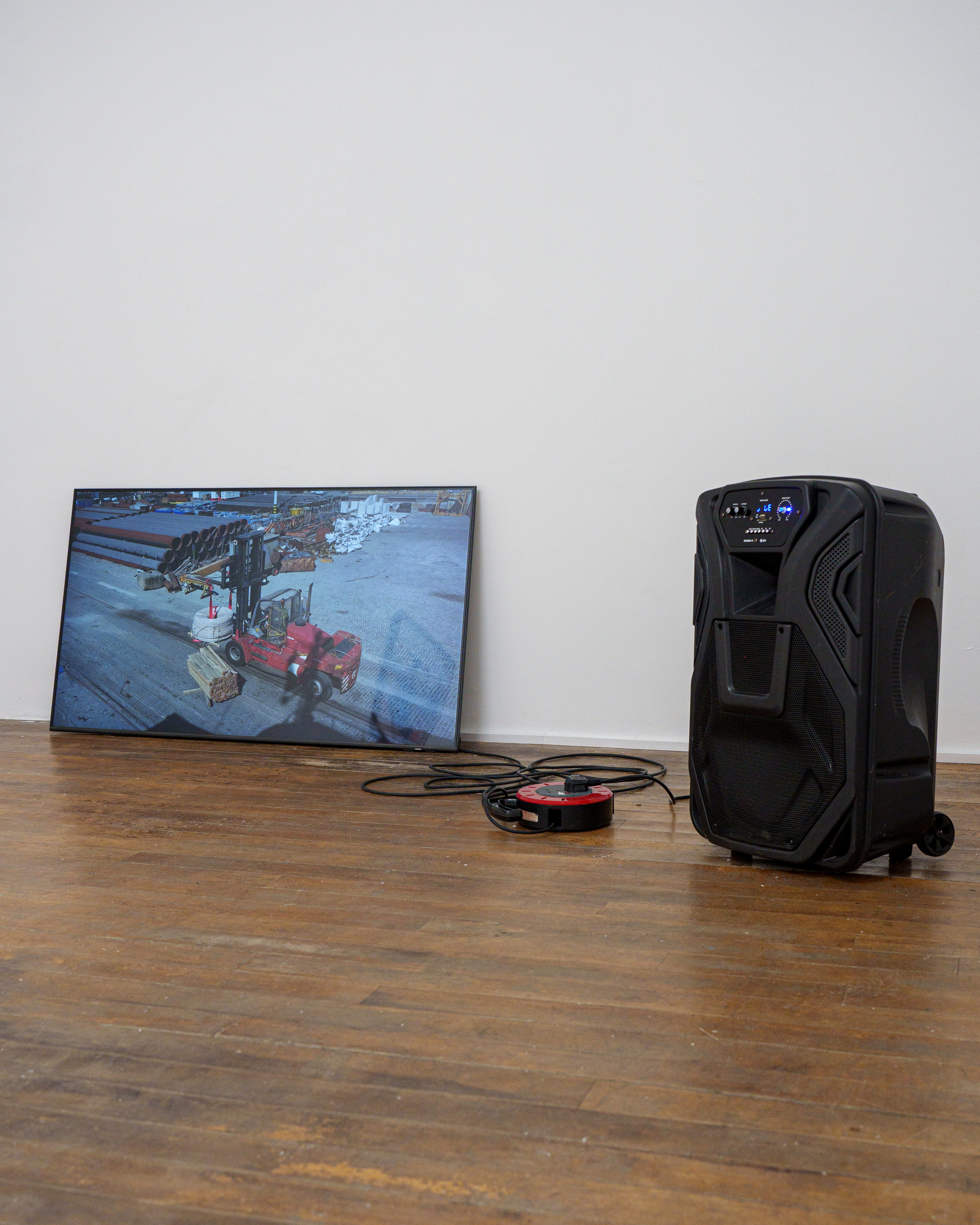
Hulk’s logic of axial rotation is reprised in TAT-8 (2025–26), a video in which optical cables spool from circular chambers deep within the hold of a docked ship, onto several large rotating metal armatures sitting on the quayside. The eponymous transatlantic communications cable, installed in 1988, was the first to use optic-fibre technology. Marron’s video, which engages with the cable’s decommissioning process in 2025, is shown on a screen that sits on the floor, resting against a wall. Audio plays through a large well-worn Bluetooth speaker placed on the floor about a metre away. An appropriately messy tangle of mains cable occupies the space between speaker and monitor. TAT-8 alternates on this screen with a TV advertisement produced by AT&T in 1988 to mark the cable’s installation. The advertisement’s MPEG compression artefacts, 1980s ad-man aesthetics, and overblown corporate positivity emphasise the span of time between now and then. One could retrospectively read its hyperbolic on-screen text, incorporating engineering terms such as ‘telemetry’ and ‘data-networking’, as a premonition of the information superhighway that, a few years later, changed human life forever. Inserting this video at TAT-8’s loop point disturbs the usual gallery protocol of ‘a single looped video on a single screen’. Placing the two videos in a looped sequence like this poses questions that open a rich space for dialogue and reflection without fanfare.
In these video works, Marron focuses on situations where human bodies brush up against technologies that are active at very different spatial and temporal scales. In Hulk, two workers periodically pause the machine to load metal bobbins of optical fibre onto it at the turbine/loom end. The bobbins are heavy enough that they need to use mechanical hoists to complete the task. It’s a serious job, but there’s a comfort and familiarity in their movements, a sense of deeply engrained body-knowledge and camaraderie. In TAT-8, workers sit on quayside platforms, flanking metal apertures mounted on adjustable stands. As the obsolete fibre passes from ship to shore, they raise and lower the apertures to guide it evenly onto the revolving mega-bobbins. Rotation is halted when a bobbin is full, and a forklift driver and his mate arrive to remove the coiled fibre. They transport and deposit it to one side of the quay, at the end of a row of similarly car-sized bundles of techno-spaghetti. There are shades here of the ‘artificial artificial intelligence’ of Amazon’s Mechanical Turk, in the sense that the sociotechnical systems captured in both videos communicate a desire for a currently unattainable state of total automation. One can sense the designers’ grudging acceptance that certain facets of the task at hand require human dexterity or judgement. Like Ruffino, Marron observes the cultures and human relations that emerge through the inhabitation of these interstitial spaces: the hand-made adjustments to the machine in Hulk and the classic rock radio station keeping TAT-8’s cable wranglers company.
Fiona Marron, The centrality of bodies, 2026, installation view, Pallas Projects/Studios. Photo: Serhii Shapoval. Courtesy of the artist and Pallas Projects/Studios.
The human body also asserts itself in Marron’s camerawork. In an echo of the aesthetic shifts catalysed by the social-media sphere, the locked-off shots and crisp film-crew perfection of her earlier works have given way to an approach that is more contingent. In TAT-8, for example, there are moments where we see her red Adidas trainers as she roves, lens pointing downwards, across the deck of the ship. At times, the camera moves like an eye, as if to orient its operator, scanning around for the source of a noise or following the fibre from a hole in the deck, through the railings and out onto dry land. While one might read this change in approach as a shift from the performance of objectivity to the performance of subjectivity, and/or an acknowledgement of the inevitably partial act of creation taking place, there is also the sense that Marron is trying to capture some sense of her role as a potential contaminant within these systems. This is further emphasised by a sequencing of shots that ignores the chronology of the manufacturing or recycling processes taking place in front of the camera. Instead, the edit conveys a sense that these processes are always already ongoing but largely hidden from view.
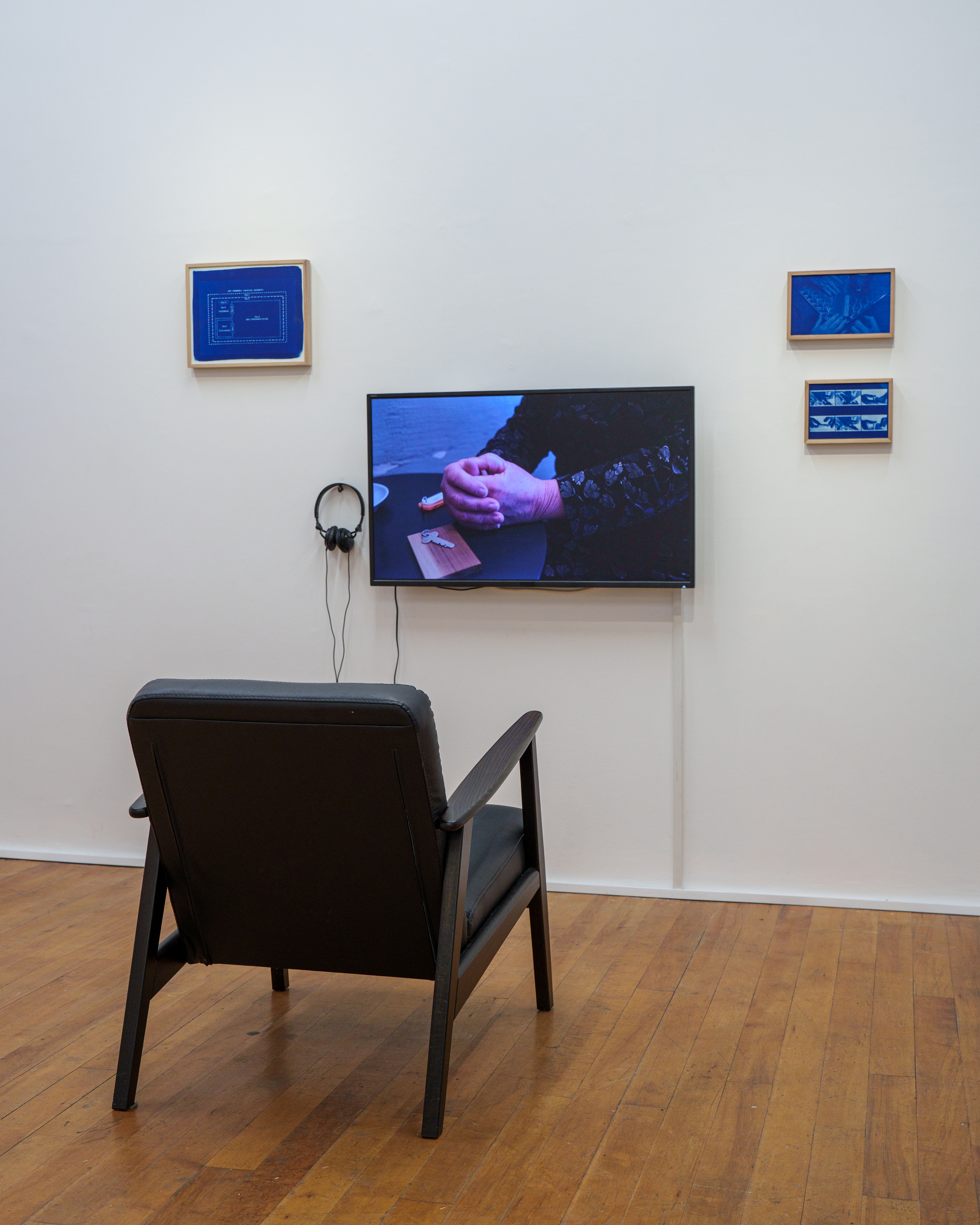
A third video, entitled fika (2021–26), centres on an interview with Anne-Marie Eklund Löwinder. Eklund Löwinder describes the role she played in maintaining the security of the internet DNS system from 2010 to 2022. Marron’s camerawork here mirrors the embodied style of the other videos. In this video we hear Eklund Löwinder’s voice and see her hands, but we never see her face. She describes participating in a ‘ceremony’, culminating in a dual key authentication scheme, which riffs heavily on the use of physical human presence as a kind of fail-safe in Cold War–era nuclear missile launch scenarios. Hung around the wall-mounted screen on which the work is displayed, one of the three cyanotypes is a literal blueprint of the highly secured space in which the key ceremony takes place. On-screen, the interview footage is interrupted by short interludes of black screen at irregular intervals. The other videos exhibit the same behaviour. As well as emphasising the transitions between shots, these glitches resonate with themes of continuity and discontinuity that recur in the works themselves, the processes they address, and communications technologies in general.
Fiona Marron, patterns of, limited-edition, hand-bound Risograph-printed booklet. Photo: Fiona Marron. Courtesy of the artist.
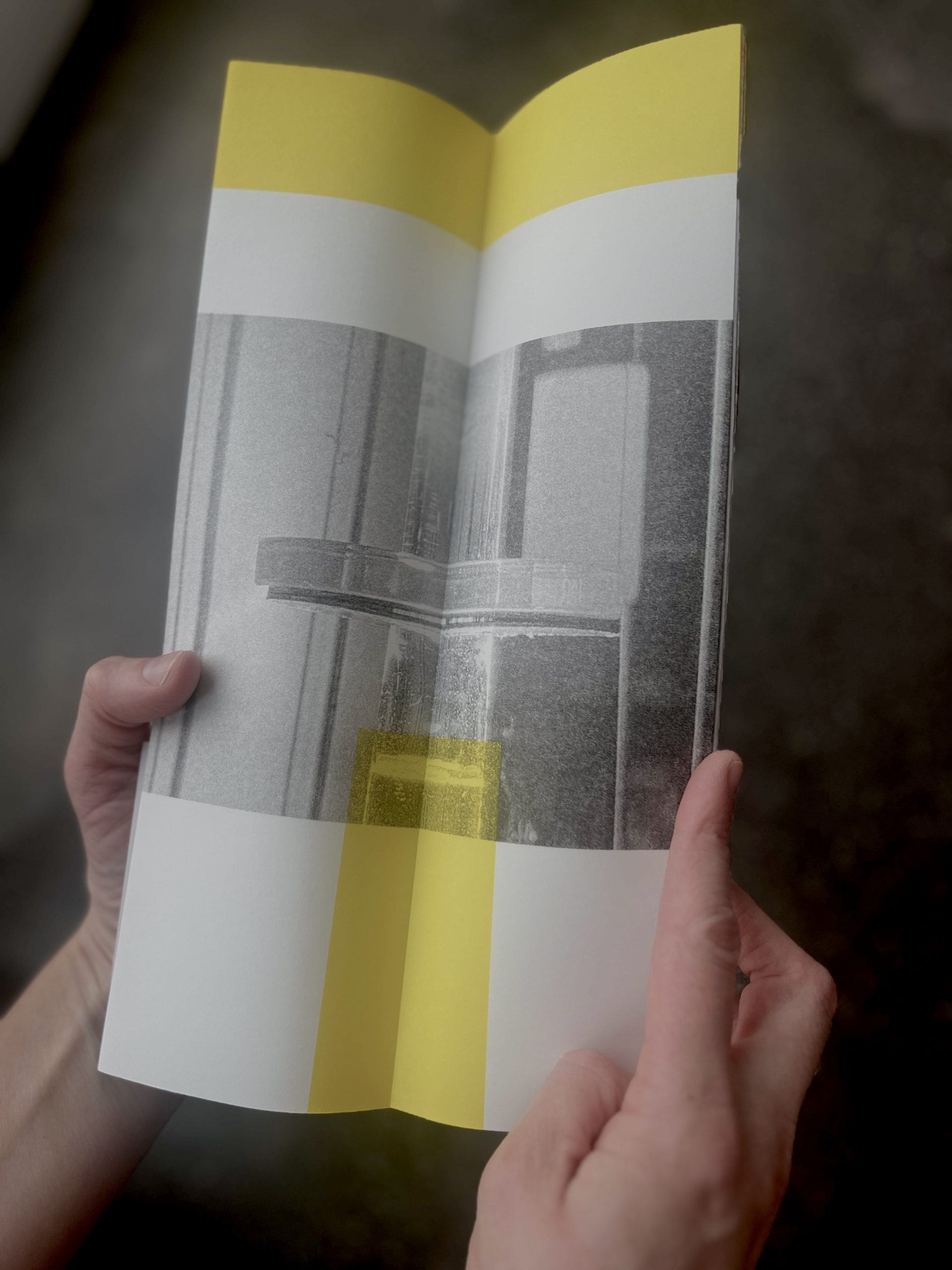
The centrality of bodies is accompanied by a modest but exquisite Risograph publication that is hand-bound with black cord. Its unorthodox format reconfigures the typical zine, where folded A4 pages are nested inside each other and held in place with a staple or two. Instead, the folded pages of patterns of are stacked on top of each other and bound together at their edges, placing continuities and discontinuities in unfamiliar places, and producing a topology wherein each page possesses an interior space. The strategy of estrangement continues in the decision to fold the page length-ways, thus creating a long thin page that mirrors both the form of the exhibition pamphlet and the extruded forms of the optical cable repeaters. Imagery, shot across two optical cable manufacturing sites in Sweden in 2024, is printed to bleed across the folds, manifesting as slightly misaligned layers of colour that possess something of the quality of a malfunctioning analogue monitor. The cumulative effect of these structural twists and turns is, not only, to emphasise the publication’s object-ness, but also, to suggest infrastructure’s power to reconfigure experience. The care and consideration invested in patterns of manifest across the exhibition as a whole, culminating in the realisation that your own body has been centred as a respondent to its field of carefully calibrated propositions.
Dennis McNulty is an artist, researcher, music-maker, and instrument designer. He is currently a funded research assistant at Trinity College Dublin in Prof. Dan Kilper’s research group, where he thinks about the role of diagrams in cross-disciplinary collaboration, particularly in quantum networking research. www.dennismcnulty.com
Notes
[1] Amy Sillman, Donna De Salvo, Helen Molesworth, host, Dialogues: The David Zwirner Podcast, podcast, 18 February 2026, https://play.megaphone.fm/xeywlausrkcezputc7iorq.