A tight, stark white corridor with a single light suspended from its low ceiling forms the entrance to Andy Fitz’s Now now. While walking through a narrow white corridor is not in itself unusual, the severity of this one suggests something more surreal, almost sterile. The walls are pristine, finished with a shadow gap skirting that gives them the illusion of floating. The door isn’t particularly recognisable as domestic or commercial; more clinical, with a firm white handle.
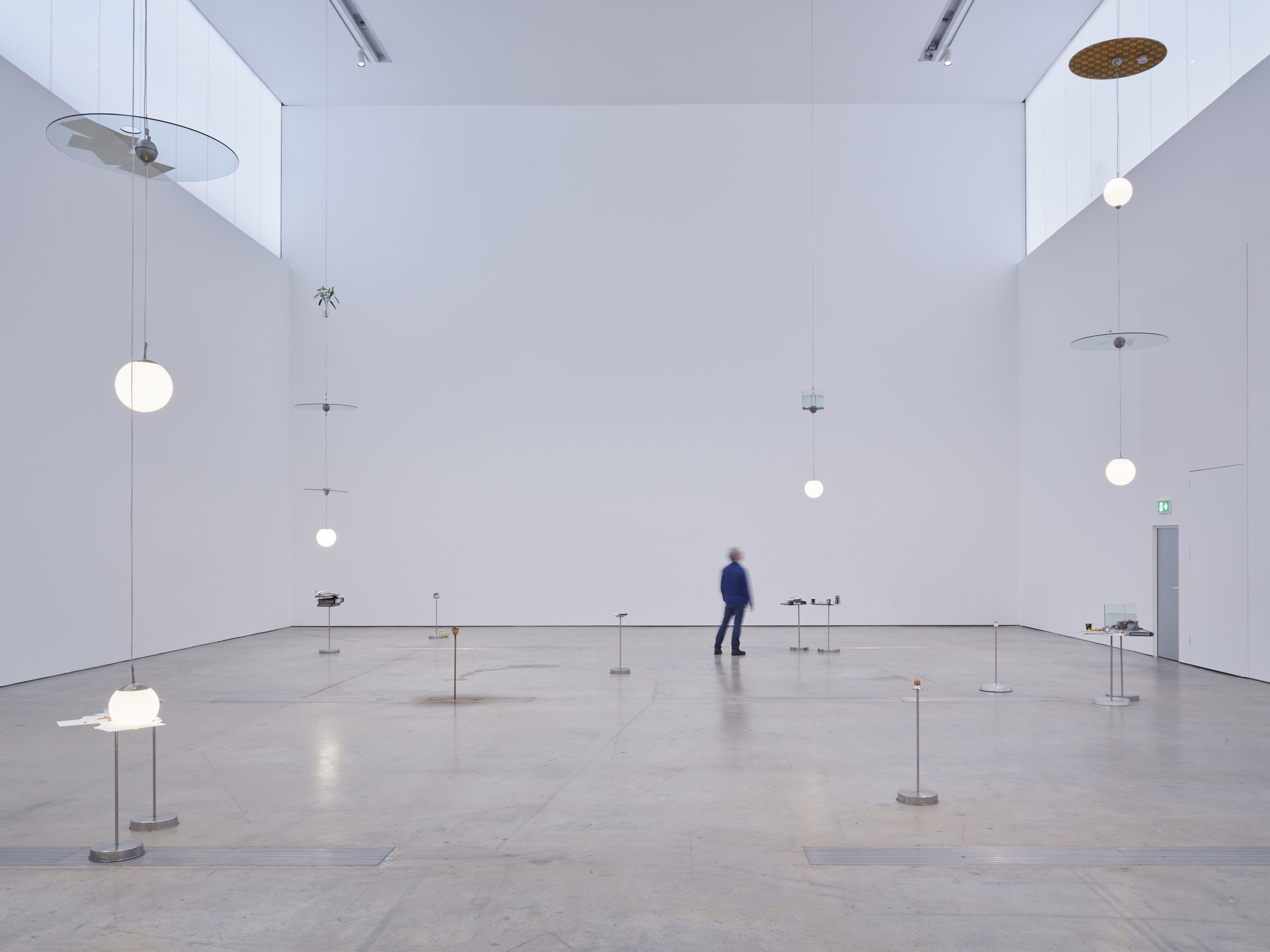
The contrast between the corridor and the vastness of the gallery is stark, and highly effective. Despite the dramatic difference in scale, a consistent sense of intention (and a distinct impression of modernity) carries through both spaces. Dotted across the gallery floor, without apparent order, are around a dozen brushed stainless steel stands, the kind often used as barrier posts or to support a small tabletop. Each stand supports a miscellaneous array of objects, many of which appear to hover, as if on the verge of falling. Directly above most of these arrangements hang elongated light fixtures, suspended by thin cords. Their globes emit a warm glow that is largely redundant in this context, given the abundance of natural light. The cords act like skewers with various other surfaces perched along their lengths: delicately suspending glass discs, stiffly folded blankets, and, at one point, a glass tank of water hovering delicately above my head. I attempt to take in a photo of the whole room at once: I stand against the back wall, holding my phone close beneath my chin to widen the frame. When zoomed out, the brightness of the bulbs, complemented by their arrangement, begins to resemble a kind of solar system. Each light is a sun, orbiting within its own field. If the entrance felt faintly claustrophobic, the gallery opens into something almost cosmic in scale.
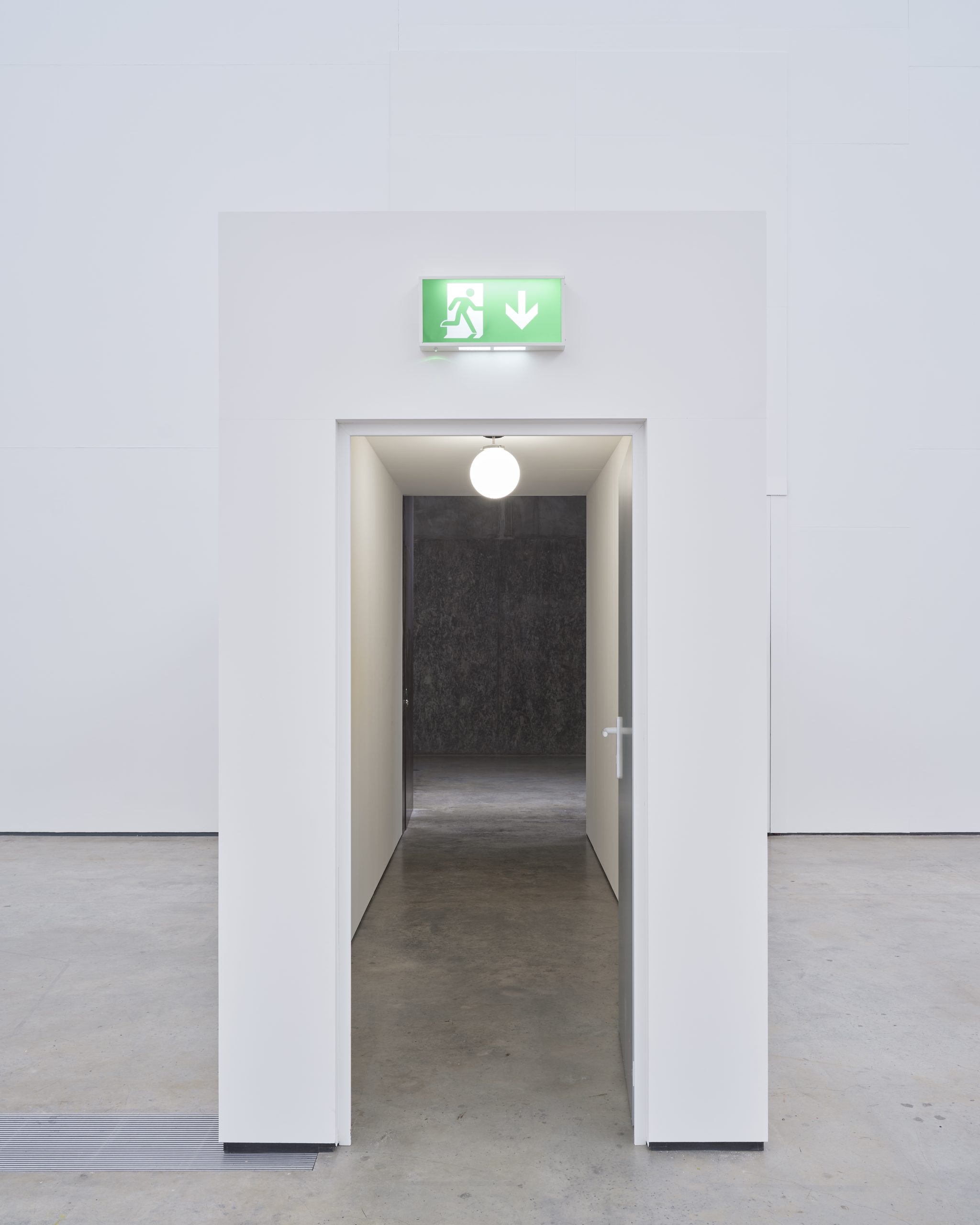
Andy Fitz, Now now, 2026, installation view, VISUAL Carlow. Courtesy of the artist and VISUAL Carlow. Photo: Ros Kavanagh.
The modernist design language throughout Now now strongly recalls early- to mid- twentieth-century modernism. This is evident in the pendant lights, whose simple geometric forms emphasise function while diffusing light evenly. Their warm glow and clean lines align with mid-century modern aesthetics, while the use of glass suggests a lightness and openness, exemplified by the style of the period, departing from the weighty ornamentation of earlier styles. The brushed stainless steel stands are distinctly industrial, both in material and in their repeated replication across the gallery floor. Ornament is largely absent. Apart from a ceramic swan or two, each object either serves or implies a function. While we might encounter objects made in styles like this in everyday life, they are rarely assembled in strict cohesion, suggesting that Now now belongs to or signifies another era.
On top of this modernist framework, Fitz builds a distinct material language across the assemblages, largely grounded in paper-based objects like notebooks, binders, folders, legal pads, loose sheets, Post-it notes, books, magazines, and receipts. While the press release frames these objects as ‘domestic’, they read more like clerical materials tied to administrative labour. This is reinforced by the presence of disposable coffee cups, reading glasses, and architectural models of houses and water towers.
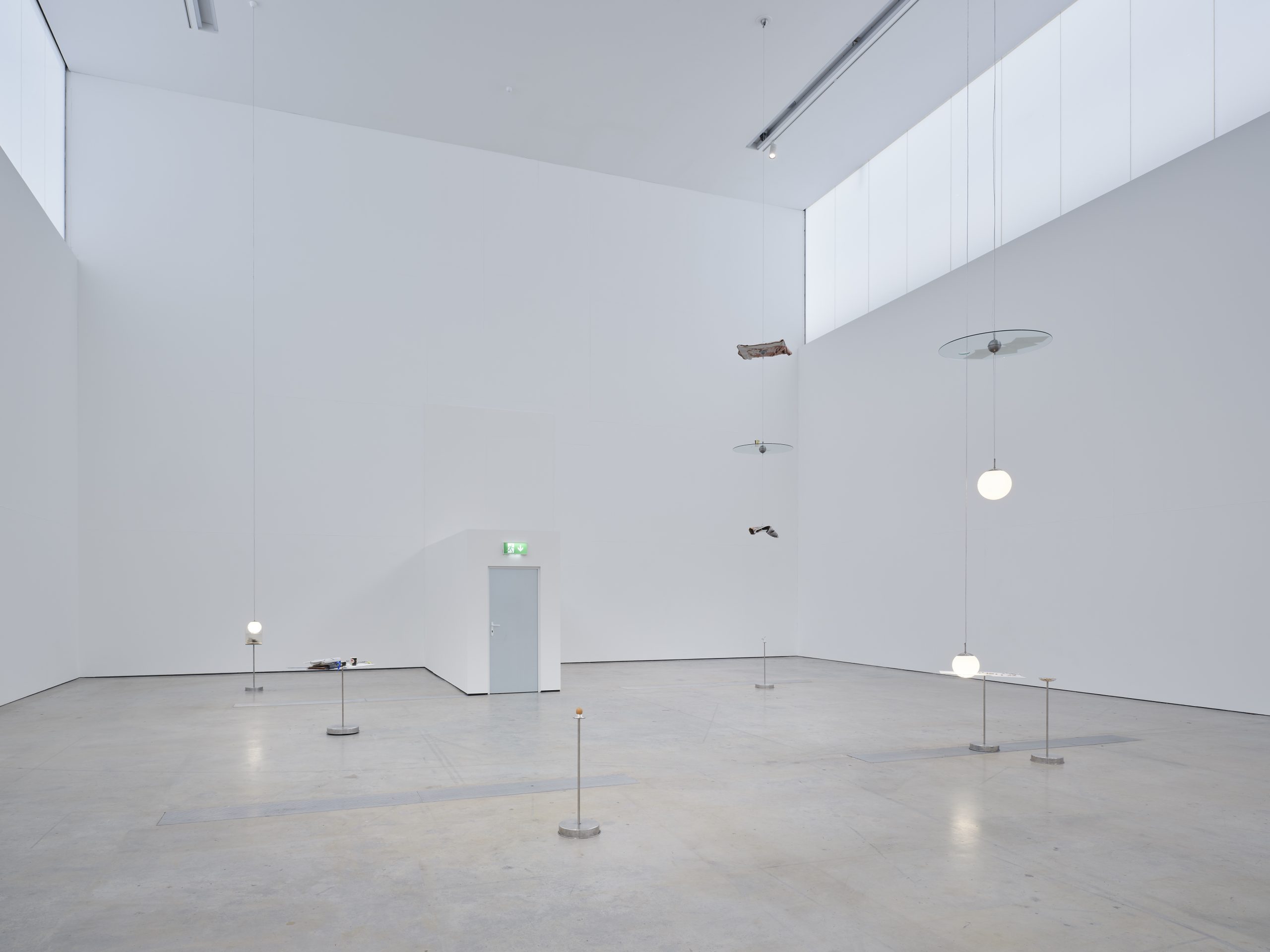
Andy Fitz, Now now, 2026, installation view, VISUAL Carlow. Courtesy of the artist and VISUAL Carlow. Photo: Ros Kavanagh.
Surprisingly, among these piles, butterflies appear, although partially hidden. One butterfly is carefully preserved between tape and a scrap of paper, another delicately splayed out in a rigid, clear box file, and a black display case containing an impressive collection is suspended from the light fixtures, partially wrapped in newspaper. The concealed nature of these butterflies might suggest a repressed curiosity, or a desire to preserve, categorise, and control what is delicate or beautiful. Yet even here, the logic of organisation persists. Labour remains at the core of these assemblages.
Food items like hard-boiled eggs, toast, salt in dispensers, scattered almonds, and packaged fortune cookies sit around and on top of files, maybe signs of a meal eaten at a desk, or a quick breakfast on the way to the office. There is an implication here of an all-encompassing relationship to work. Bundles of keys also haphazardly appear among these materials, as if the worker remains tethered to the workspace. The analogue nature of these materials, in contrast with the digitised space of the present-day office, again seems to situate us in a receding past, reinforced by ashtrays and cigarette butts, reminiscent of when smoking in offices was commonplace. There is something nostalgic – or dare I say, aspirational – about this environment, imbued with some longing for a time when jobs and lives were not mediated through screens and algorithms. People enjoyed job security, homeownership was not a glib fantasy, and filing systems were analogue, requiring the tactile handling of information; all within spaces appointed with well-designed, high-quality modern furniture.
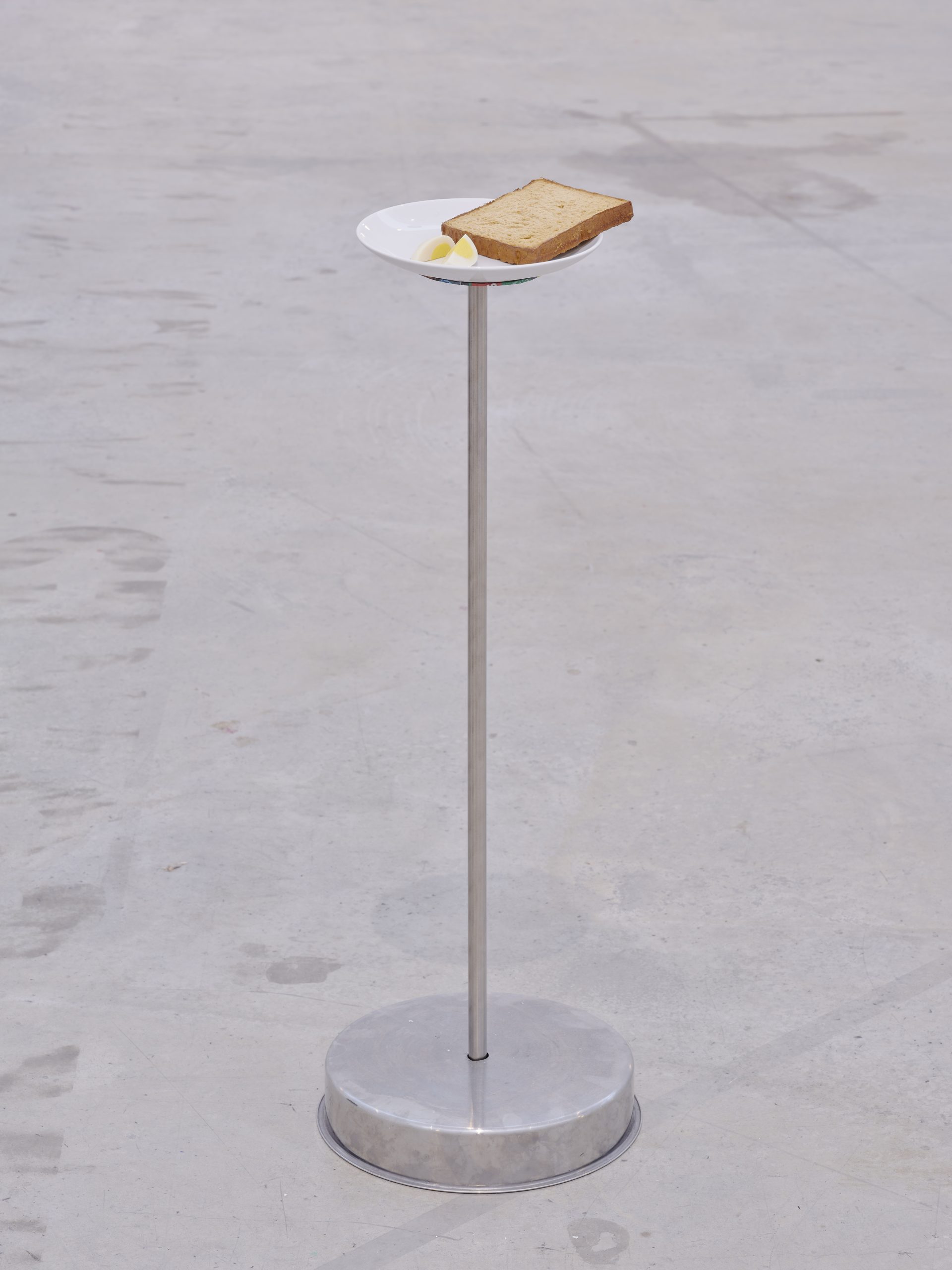
Andy Fitz, Now now, 2026, installation view, VISUAL Carlow. Courtesy of the artist and VISUAL Carlow. Photo: Ros Kavanagh.
But the most curious element of Now now is its overwhelming Germanness, with objects printed or branded in German: newspapers, folder labels, books, receipts, magazines, dimple keys (a flat, more secure alternative to traditional jagged keys). The notebooks and paper stock are not those typically found in Easons. The stereotype of Germany as orderly, efficient, and systematised – and its connection to the evolution of bureaucracy itself – seems to underpin this dense culture of record-keeping. Through these cues, Fitz constructs a scene that reads as the ephemera of clerical work in 1960s Germany, the middle of the postwar economic boom in Western Europe. The figure of an Angestellter, a white collar, salaried employee, who worked (and smoked) at his desk, enjoyed high job security – a professional distinct from manual labourers who at the time did not have the same legal protections. By the end of the decade, those outside the privileged classes grew increasingly restless amid mounting social and political upheaval. Riding the wave of the protests of 1968, student movements in Germany challenged bureaucratic conservatism, consumer culture, and the lingering influence of authoritarian institutions.
Now now effectively registers tensions such as these, which are not unlike the rising tensions of today. A cup of coffee, filled to the brim, intermittently spills over; a low-hanging light grazes the surface of a water tank, inducing the threat of electricity and water; a tall stack of binders, uneven folders, and open book supporting a delicate glass ashtray, all held in the balance by a thin metal stand. Fitz builds this atmosphere of tension through accumulation, and the sense of control falters.
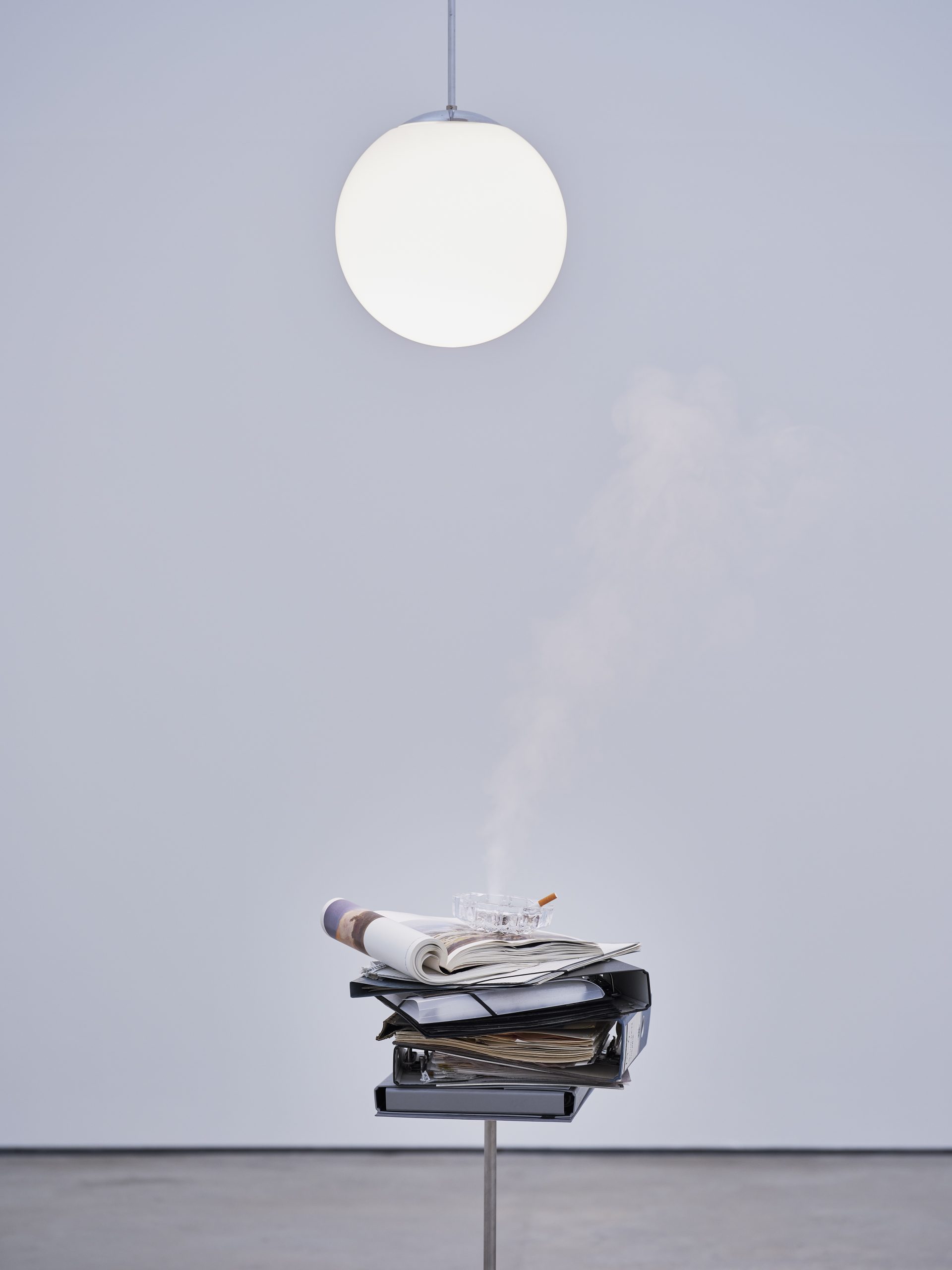
Andy Fitz, Now now, 2026, installation view, VISUAL Carlow. Courtesy of the artist and VISUAL Carlow. Photo: Ros Kavanagh.
The heavy presence of Germanic culture and design could suggest an aspirational quality to the work, compounded by Fitz’s cultural capital as an internationally embedded (Berlin-based) artist. These objects carry a sense of authority, even inevitability, as though the organisational systems they signify are neutral and necessary. Now now, however, hovers somewhere between critique and reverence, questioning the bureaucratic logic of modernity while simultaneously indulging in, perhaps even fetishising, its design qualities. Particularly within the context of VISUAL, a regional gallery situated on the ‘periphery’, there is a live risk of aestheticising, even romanticising, the textures of a more conservative and socially repressive past.
This risk is tempered, in Now now, by the anxiety that runs through the work, undoing any sense of nostalgia or romance. There is a tension at the heart of this environment, an instability beneath the surface of order. The precariousness of the assemblages, the sense that objects might slip, spill, or collapse at any moment, unsettles the apparent coherence of these systems, exposing their fragility. These rigid systems are not fixed or neutral; they are constructed, contingent, and absent-mindedly repeated (a metaphor for many of the social constructs modernity continues to grapple with: class, gender, ideology, all hanging in the balance). While I found myself taken by the work’s aesthetic pull, I could not escape the unease and fragility Fitz makes so viscerally present.
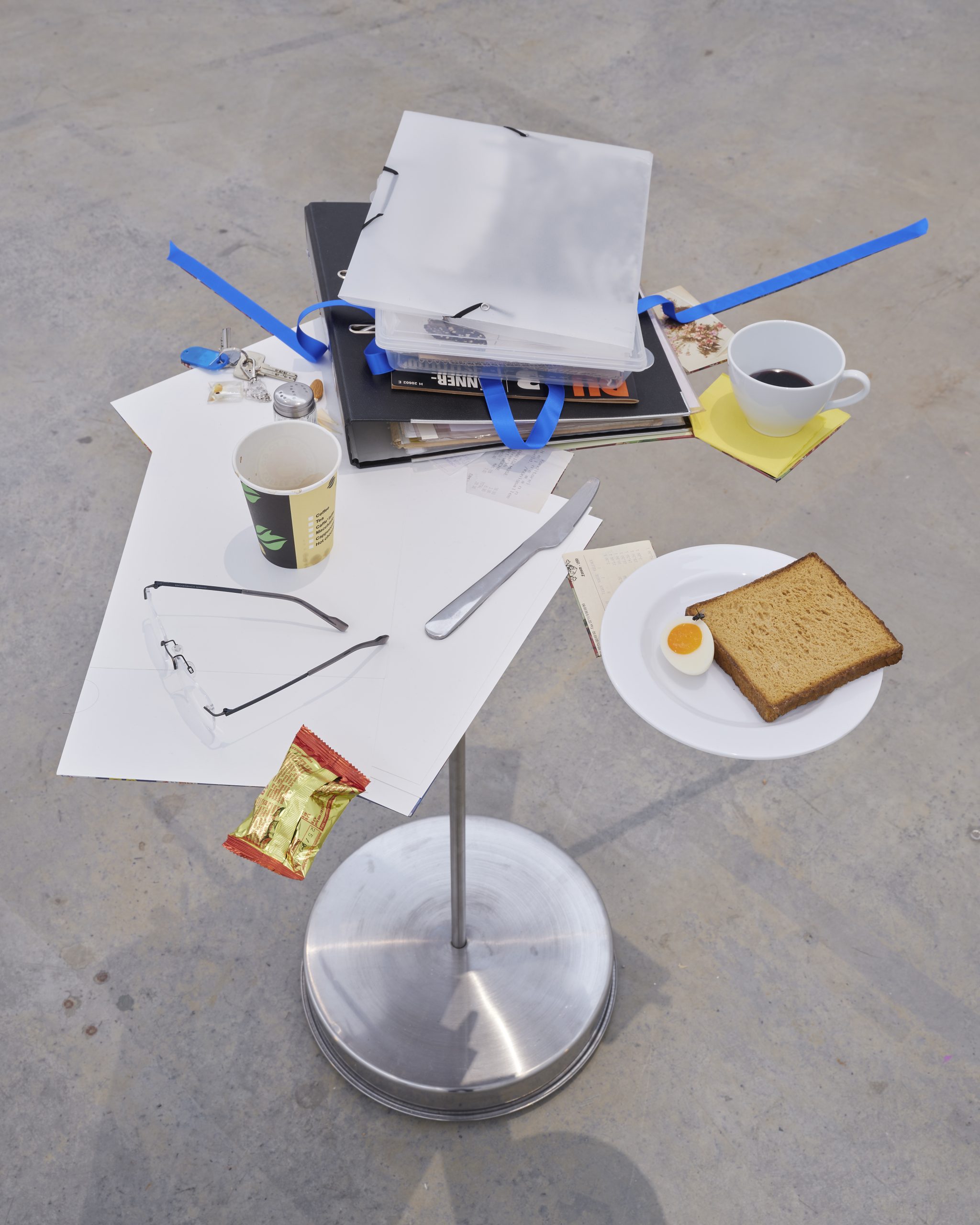
Andy Fitz, Now now, 2026, installation view, VISUAL Carlow. Courtesy of the artist and VISUAL Carlow. Photo: Ros Kavanagh.
Beneath a plate, among binders, blank pages, and near-empty paper coffee cups, lies a fading receipt that reads: ‘Loosen – 1590.’ The receipt is from a country house-style restaurant in Hotel Rheinterrasse Benrath, Düsseldorf, a beautiful property on the River Rhine, beside the Schlosspark Benrath palace gardens, under family ownership since 1967. Citing staff shortages and rising operating costs, the property was sold in 2022. The buyer plans to build eighteen luxury apartments on the site. The frequency of such transactions has accelerated frighteningly in recent years, concentrating wealth in the hands of a small few. It is tempting, then, to romanticise a time before the present-day conglomerate frenzy, when analogue technologies still seemed to carry the promise of progress. Moving through Now now, I find myself drawn into the material comforts of this world, while also remembering, of course, that this postwar optimism was inseparable from the logics of capital that have given way to the neoliberal hellscape of today. Now now both presents and destabilises these objects of nostalgia, seeming to trouble the mechanics of memory and encouraging us, instead, to imagine another future.
Sara Muthi is a curator and writer based in Dublin.