MAY 1996. A group of artists congregate outside a former knitwear factory on Foley Street in north inner-city Dublin. Its windows are gridded horizontal strips, almost Modernist, while its once-white facade is pockmarked with rust stains and name tags, teenage declarations of love: Jackie + Jimmy, Carolyn + Sean, another Carolyn (or perhaps the same one?) + Gerard. Carrying cardboard boxes of tools and art materials, the artists enter the building through blue double doors. A large industrial space with fluorescent tube lights and bare concrete floors, it’s vacant except for some boxes of knitting patterns, spools of thread, and letterheads printed with the name ‘PALLAS KNITWEAR’. The boxes will later be thrown out, but the name PALLAS – conjuring, as it does, glittering images of a triumphant Pallas Athena – will be kept.
Much like the Greek goddess (of war, craft, and wisdom, no less), this new Pallas will take on many shapeshifting guises over the next thirty years, manifesting as Pallas Studios, Pallas Heights, Pallas Contemporary Projects, Pallas Projects/Studios, and most recently, Pallas Open Projects. The project will hopscotch between twelve sites across Dublin city, provide much-needed studio spaces to many hundreds of arts practitioners, and organise hundreds more projects, exhibitions, and events.[1] Some of the artists standing in this building, looking askance at scattered boxes of knitting patterns, will remain intimately intertwined with Pallas for many years (among them founders Mark Cullen, a constant presence at the helm, and Brian Duggan). Others will move on to other projects, other places – or will go away and come back – while several new generations will join them.
This is a mirage, of course: I wasn’t there in 1996, and it’s probably as hard for me to imagine what it was like to walk into that knitwear factory as it would have been for them to imagine me sitting at my iMac and typing this thirty years later. My staged reimagining is based on a few surviving photographs and the stories I’ve been told, chiefly by Gavin Murphy, among an early cohort of artists to take a studio at Foley Street, who returned around 2006, first as Assistant Curator, then Co-Director with Mark. As a writer and curator, I find myself compulsively pulled towards the underground artistic currents of the late twentieth century and have to continually resist the urge to mythologise scenes like the one described above. But really, vacant industrial buildings? Boxes of knitting patterns? Young artists coming together and uniting for the common good? No romanticisation necessary; it writes itself.
Thankfully, those steering the ship at Pallas (now Pallas Projects/Studios, referred to as PP/S henceforth) are less prone to nostalgia. Mark and Gavin have stayed true to the project’s original mission of supporting early-stage practice. Along with a nimble-footed adaptability on a practical level, this sustained conceptual engagement with ‘emerging grassroots, alternative and non-commercial practices’[2] has allowed the project to survive – thrive! – for many years since (and hopefully many more to come). But reaching a thirty-year landmark provides ample cause for reflection – not least because PP/S’s celebratory programme includes some star returns, broadly reflecting on its three-decade trajectory. So, please indulge me in looking back.
****
The first Pallas exhibitions took place at the aforementioned Foley Street former knitwear factory in 1998, two years after its establishment as a studio complex. Fragments survive on PP/S’s website: the programme kicked off with a mysterious project titled XI(ent)! Die? No! Might*, an ‘international show with external curators’, while many of the early exhibitions showed studio artists. Trawling the online archive, I flick through digitised photo albums of beaming faces, bodies leaning against plinths, sipping cans of Guinness, smoking cigarettes indoors. I recognise many of the listed artists’ names – Aoife Desmond, Katie Holten, Orla Whelan, Clodagh Emoe – but find it harder to pick out faces from the crowds. Display styles are, at times, intentionally chaotic, democratic: the press release for a show titled Salon 99 promises that ‘a chorus of condensed images will replace the cool space of the modernist gallery’.[3]
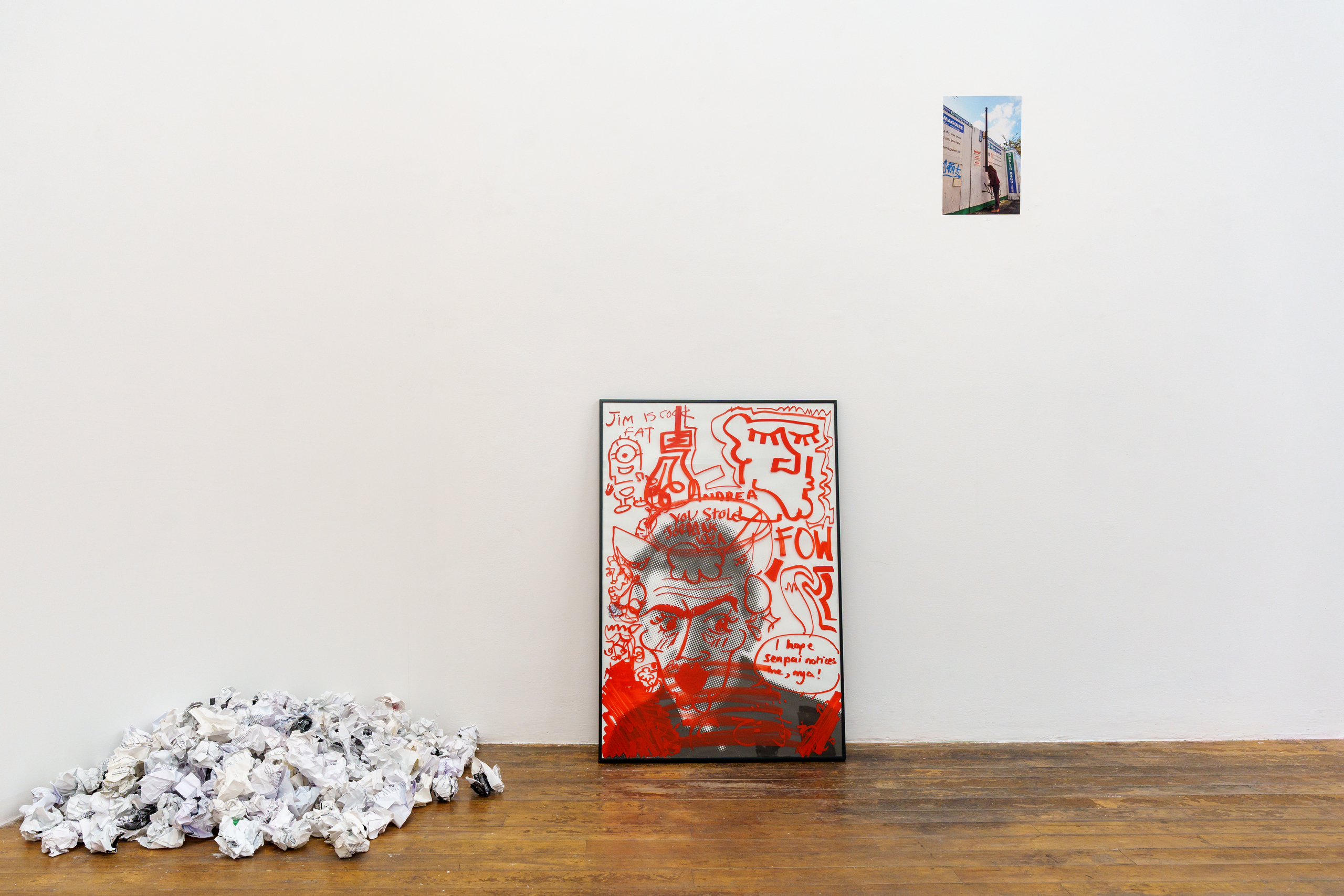
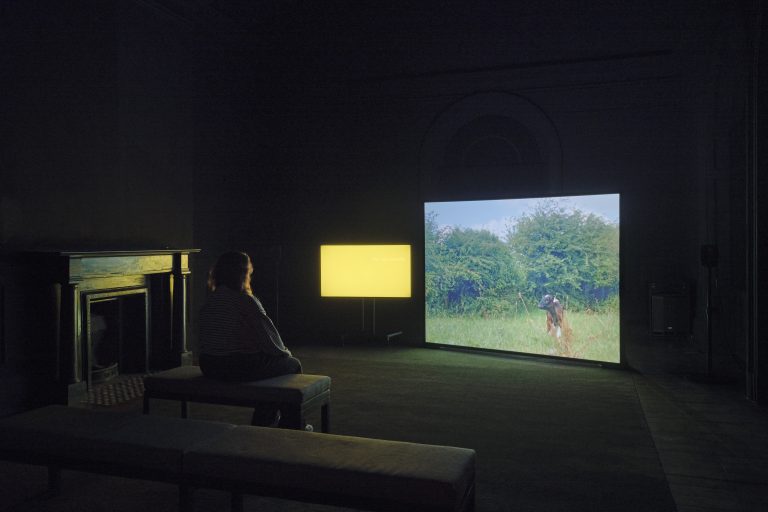
Do It Together, Pallas Projects/Studios, installation view, 2026. Courtesy of Pallas Projects/Studios. Photo: Serhii Shapoval.
By 2000, the programme was already spilling out of its original site: Pallas 00 brought a cohort of Dublin artists to an exhibition space at London’s Truman Brewery. (Its flyer design, so of its time, would ironically be lapped up by the many ‘y2k’ vintage shops that now inhabit the Brick Lane site.) Soon after, Precinct (2000–1), a public art project and prescient critique of urban regeneration, placed irreverent images along site hoardings, first on Capel Street Bridge and the old Adelaide Hospital, then later around Belfast, in collaboration with fellow artistrun space Catalyst Arts. By the mid-2000s, Pallas was being invited into venerated institutions, albeit bringing its anti-establishment ethos, with Offside and Offside: Live at the Hugh Lane (both 2005), happenings that stretched the spatial and temporal limits of the museum, situating artworks on the concourse outside the entrance, in a nearby retail unit, or in after-hours performance events. A few years later, it took part in Dorm (2010) at the Model, Sligo, a dense and thorough showcase of twenty-two international artist collectives curated by Seamus Kealy. But we’re jumping ahead.
That original knitwear factory still looms large in my imagination though and so, searching for traces of its continued existence, I plug its address into Google Street View and am surprised to find that a fragment of it survives. The earliest ‘archived’ view on Google is from June 2009. Even then, most of the building had been knocked down, but half a wall and one door lingered on, the phone number for its former neighbour, Applerock Studios, still listed on the metal gate flanking it to the left. Fittingly, the demolished section was covered in hoardings of the kind embellished by Precinct, advertising a plethora of gigs (Manic Street Preachers, Paolo Nutini, Junior Boys). Flicking through the next decade of images, the gigs dwindle away, leaving only the likes of Take That, a sombre chronicle of the decline of Dublin’s live music venues. Sometime around 2020, the hoarding and surviving structure were painted black – an attempt to make them disappear in plain sight, perhaps – and the remaining posters (mostly festivals) left in tatters. By 2022, they were completely gone, leaving five readymade abstract paintings in reverse: electric blue rectangles left uncovered by the surrounding black ground, the only surviving evidence of cultural life.
****
The first sixteen years of PP/S’s existence were nomadic. As well as the Pallas Knitwear factory, the organisation inhabited four flats in the now-demolished Sean Treacy House on Buckingham Street, a former milking parlour in Smithfield, an old engineering works on Grangegorman Road, a dilapidated Georgian townhouse on Dominick Street, and its current home in a schoolyard in the Coombe. This geographic orbit, tracing the peripheries of Dublin’s city centre, offers a telling insight into the role artist-run spaces often occupy – pushed to the margins of the city, inhabiting the gaps left by the decline of local industries and community spaces.
This cross-city journey is echoed by the many places I, too, inhabited during my ten years of living in Dublin. They include a flat in Stoneybatter, which was on the cusp of gentrification; carved-up segments of Georgian townhouses (one lovingly restored; the other, like PP/S’s, teetering on the brink of dilapidation – and eventually taken into receivership); a flat in the Liberties, which horses trotted past daily. Such a peripatetic existence can deepen one’s understanding of a city, but it’s also exhausting – and a distraction from more fulfilling, creative work.
Since 2012, almost half its lifetime, PP/S has been rooted in Dublin 8, allowing it to extend its tentacles deeper into the community it now serves, though not without an ongoing battle to exist. Resources, time, and energy are still spent negotiating lease extensions – time that could be spent programming, building more international connections, or supporting more artists. These battles continue a thirty-year line of bullshit that the organisation’s directors have had to contend with: installing external plastic guttering to redirect an internal leak in Foley Street, for instance, or having to shunt studio spaces from one side of a building to another so that landlords could avoid giving them rights of tenancy at the legally required mark, four years and nine months to be exact. Trying times lead to canny solutions, so it’s for this reason that Pallas has often occupied multiple spaces at once, hedging its bets against homelessness in a world of precarious contracts and rapidly shifting economic landscapes.
****
Of course, unconventional contexts and in-between spaces can also offer fertile ground for artists to inhabit and respond to. Pallas Heights (2003–6) temporarily inhabited four flats on the top floor of Sean Treacy House, a municipal housing project earmarked for demolition. Programming exhibitions in this setting meant having to respond sensitively and compassionately to its very particular social context, still home to a dwindling number of residents. (Retrospectively looked back on as the ‘boom years’, the archive reminds us that such ‘booming’ wasn’t shared by everyone.)
Despite its built-in precarity, Pallas Heights is one of the best-documented of PP/S’s early exhibition sites, thanks to a 2007 publication. The same anti-white cube spirit that drove Salon 99 manifests here as bulbous, gloopy sculptures suspended from a popcorn ceiling (PONR group exhibition, 2003); tangles of branches tumbling out of kitchen cupboards (APT. 30 by Slavek Kwi, Seoidín O’Sullivan, and Gillian Kane, 2004); or ticking clocks embedded into stud walls, counting down to impending doom (Sea of Unknowing by Margaret O’Brien, 2005). On the ‘streets in the sky’ outside, artists are interspersed among local kids in hoodies; curators duck under lines of washing to get to the entrance.[4] There’s something spooky about seeing art installed in an abandoned domestic setting – rather than filling the void left by ‘life’ it seems to heighten it, to make the absence more acutely felt.
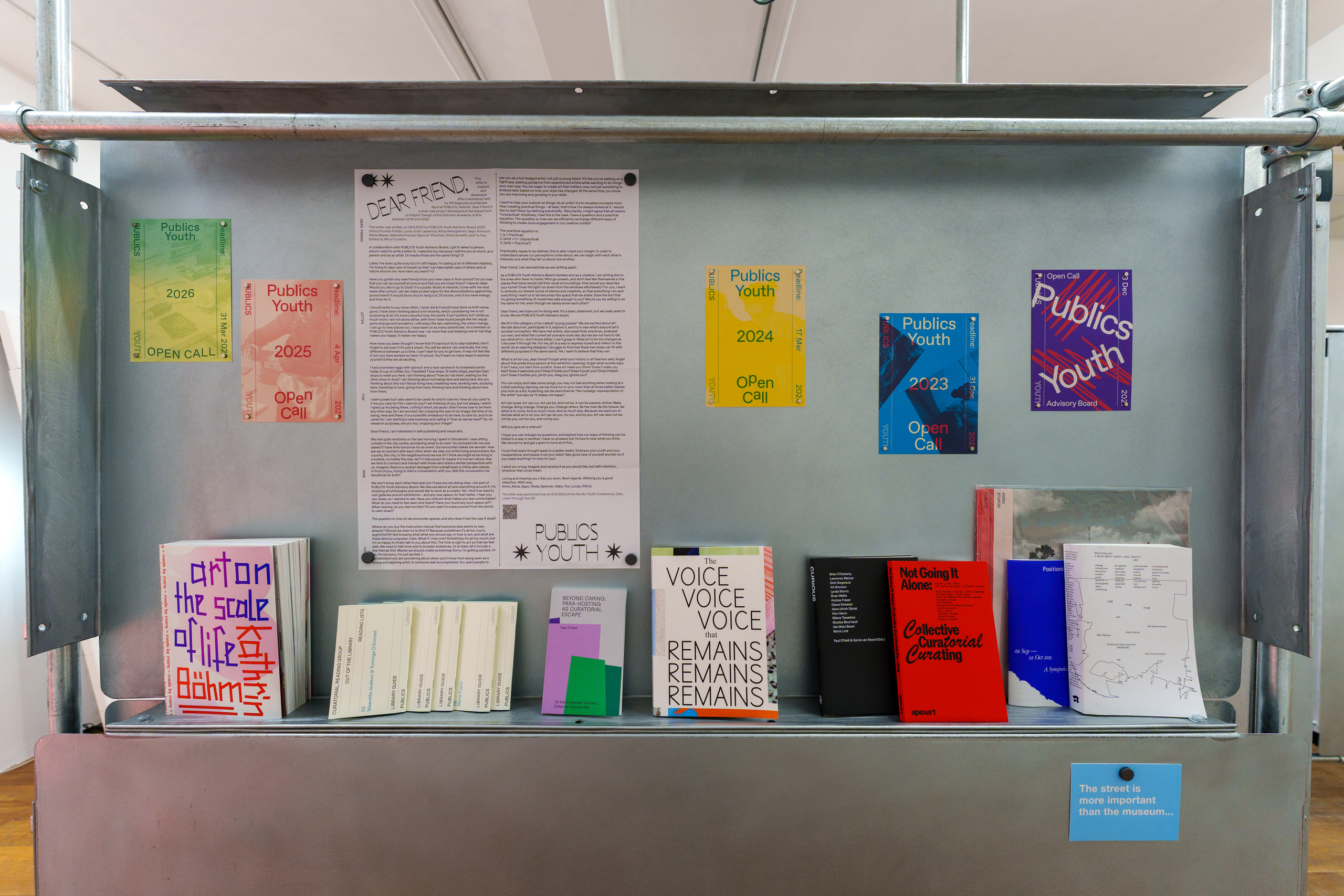
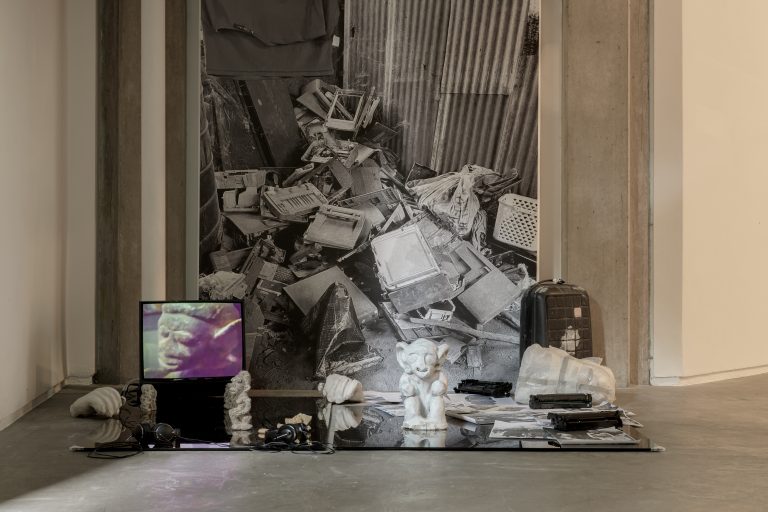
Do It Together, Pallas Projects/Studios, installation view, 2026. Courtesy of Pallas Projects/Studios. Photo: Serhii Shapoval.
Garrett Phelan’s 2003 installation now:here takes this feeling a step further, covering the walls of a flat with esoteric drawings in black marker pen that – particularly in the grainy pre-digital installation images – look like something from True Detective. Daubings of factory-like machinery jostle with flowchart-style diagrams, religious symbols, and corporate icons, annotated by words with singular resonance: ‘truths’, ‘heavens’, ‘energy’. These manic, paranoid, yet strangely profound drawings feel curiously at home against the pockmarked facade of the flat’s walls, painstakingly stripped back to reveal patches of Polyfilla and peeling paint; a shrine of Leeds United memorabilia left on the back of a bedroom door. If Phelan made the domestic seem sinister, then Brendan Earley’s installation rendered it downright otherworldly – filling it with illuminated square tiles and a mysterious, monolithic sculpture that evokes 2001: A Space Odyssey.
Another key body of work from this period came from Jesse Jones, who engaged extensively with the local community in preparation for two films shown in 2005. May Day documents a group of Turkish migrant builders, employed on the Ballymun regeneration project, as they protest unfair working conditions. The second film, On the Waterfront, captured a drummer and two trumpet players from the Artane Boys Band (whose members were traditionally drawn from St Joseph’s Industrial School) playing the soundtrack from the eponymous 1954 film in the courtyard of the Pallas Heights flats. Jones’s evocation of this cinematic classic, which starred Marlon Brando as a disenfranchised dock worker battling against corruption, contextualised the plights of Dublin’s construction workers amid an international and ongoing struggle for labour rights.
Art is so often sealed off, kept out of contact with life, maybe, because its ‘apartness’ is what bestows it its aura as fetish object, as something miraculous and otherworldly (with associated potential to command high prices). But when art is reintegrated into a context approximating life, exciting things can happen.
****
Not long afterwards, Pallas Contemporary Projects (PCP, 2007–10) opened in a disused milking parlour in Stoneybatter – a long, narrow gallery space, since remodelled as accommodation. Despite its peculiar history, this exhibition space most closely resembled the conventional white-walled gallery setting, though that’s not to say the programme became more polite because of it. An early installation, a huge kinetic, inflatable sculpture by Clive Murphy (MONO, 2007), feels part intestine and part exhaust pipe, reindustrialising the space in the most gleeful and unexpected way. Pallasades (2008), a collaborative project developed by participants on the pcp internship programme, turned the gallery into a temporary darkroom, transforming the windowlessness of contemporary art spaces into something transformative and generative. (Scanning through the names involved in this and subsequent intern-led projects, the programme evidently launched the careers of many of the curators, writers, and artists filling institutions today.)
For one pivotal exhibition in 2009, PCP was divided in two: one side screening Hito Steyerl’s Lovely Andrea, the other Manon de Boer’s In Resonating Surfaces, both internationally acclaimed films exploring power and memory. (Steyerl would return to the programming a year later for Dorm at the Model, presenting the second instalment in this video series.) Another breakthrough film project: the first Dublin ‘solo’ exhibition by Sarah Browne and Gareth Kennedy in 2007, the collaborative duo who would represent Ireland at Venice two years later. Their film brought fossil fuel misuse into sharp relief, splicing Dáil debates on Ireland’s deadly Betelgeuse disaster with oil company ad jingles and clips from Dallas and 1970s Hollywood; its relevance remains disconcertingly undimmed.
****
Thirty years seems to me like an unfathomably vast stretch of time for an art space to have survived, until I realise I’ve been witness to around half of it. I first began engaging with PP/S when it opened its shortlived premises on Dominick Street in 2011. I was twenty-one and in my third year of college, quickly getting to grips with Dublin’s contemporary art scene by writing pithy short-form pieces for Totally Dublin for €10 a pop. Digging through long-forgotten files in my Google Drive, I managed to locate the first time I ever wrote about a PP/S project: a 175-word preview of Alex Martinis Roe’s exhibition, published in the May 2011 issue of Totally Dublin. The prose is as embarrassing as you’d think, but I must accept that this is reflective of my own slightly chaotic and DIY entry into the arts: a path forged by learning through doing, bonding over copious amounts of cheap gallery wine; never consciously ‘networking’ but forming genuine connections with people, a process that has actually fared me much better in the long run, tilling the ground for future collaborations.
What I didn’t have the context to understand at that time – and this has perhaps become clearer in retrospect – is that the year at Dominick Street was a pivotal one for PP/S. It staged landmark exhibitions, including with Ciarán Walsh, Martinis Roe, and John Smith. Smith, already something of a cult figure by 2011, exhibited his influential 1976 work Girl Chewing Gum as well as much more recent films exploring the War on Terror. PP/S’s short-lived tenure at Dominick Street also saw the first Periodical Review, now a core pillar of its programming and highlight of the Dublin arts calendar – an annual magazine-style exhibition offering a round-up of artistic highlights, selected by PP/S’s directors and two guest curators. I love Periodical Review for its refreshing eclecticism and plurality, often placing artists scouted at graduate shows beside more established names, sparking unexpected affinities and connections. Its preview events, as James Merrigan has pointed out, are also legendary: defined by an ‘excess’ of bodies and artworks alike.[5]
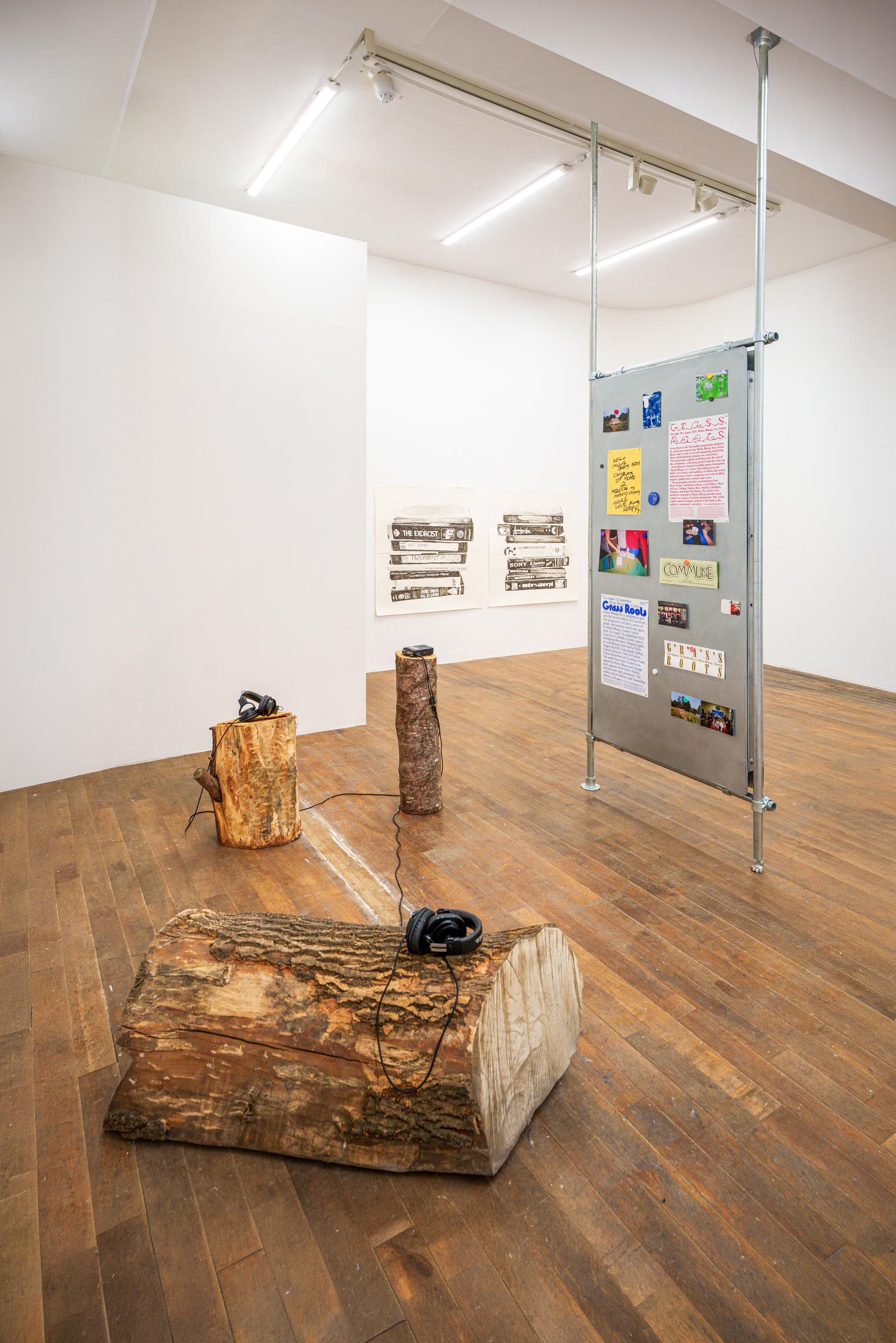
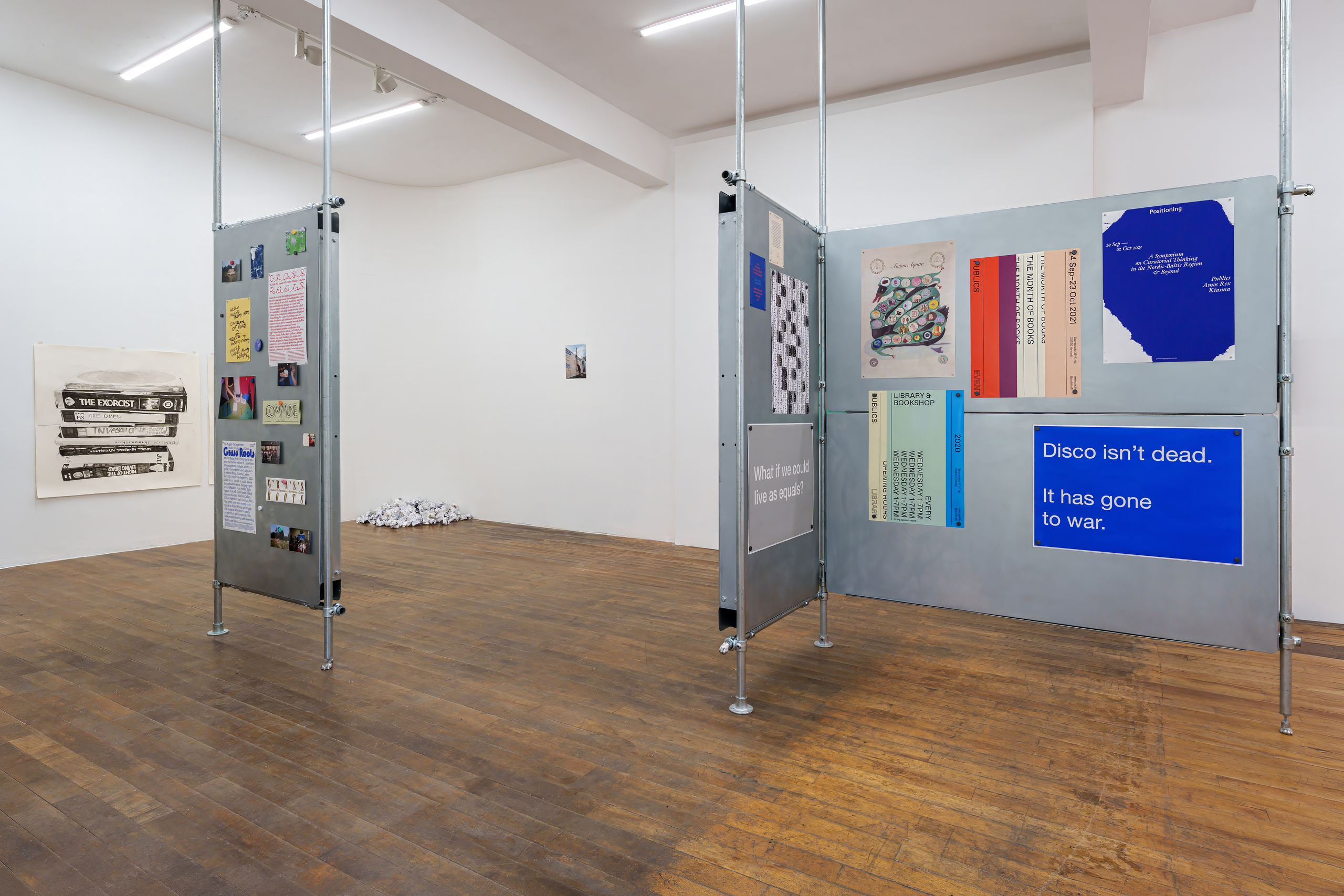
Do It Together, Pallas Projects/Studios, installation view, 2026. Courtesy of Pallas Projects/Studios. Photo: Serhii Shapoval.
I became a regular attendee of PP/S events and exhibitions once it transplanted to its current home in the Coombe. I carry, somewhere in the back of my mind, a palimpsest of memories of its gallery space and attached schoolyard: opening receptions, daytime exhibition visits, meetings in studios, and evening parties all blurring into one. One particularly incandescent memory comes back in snatches: a metal fire bin blazing in the schoolyard, cheekbones swiped with glitter, excitedly shaking hands with new people, dancing to Italo disco. What the party was in celebration of, I don’t remember – but to paraphrase Maya Angelou, I remember how it made me feel.
Such moments of connection and escapism could be easily dismissed as frivolous, but they are part of the web of connectivity through which artistic networks and collaboration thrive; through which connections are forged, information flows, and fresh ideas pump. Something generative happens when like-minded creative people share the same rooms, breathe the same air, drink cold beers from the same plastic bucket filled with ice. In the thirteen or so years since that night, such moments have grown rarer, more precious, as our lives shift increasingly online, and as the growing precarity of living an artistic life (never un-precarious) makes hosting such happenings more difficult. Spaces like PP/S, which allow such communities and socialities to thrive, must be defended tenaciously.
****
Artist-run spaces have always had to defend their existences, to stake their place in the world. And yet they are typically quicker to respond to new ideas, processes, and anti-institutional practices than museums, and less restricted by the whims of the market than commercial galleries, though all have their place in the art ecosystem. Artist-run spaces have, too, over the years, acted as incubators: a front-line for the avant-garde, for groups historically excluded by traditional institutions, for practices deemed too risky, temporal, expansive, ephemeral, or just plain weird. The global history of artist-run spaces reflects this vibrancy. Art Metropole, now the world’s longest-running artist-run bookstore, was founded in Toronto in 1974 by General Idea, a group of artists who rejected not only individualist working methods, but individual identity. (As well as taking the collective name General Idea, each member took on an assumed identity – Ronald Gabe, Slobodan Saia-Levy, and Michael Tims became Felix Partz, Jorge Zontal, and AA Bronson, respectively.) Having bonded at an experimental theatre group, the group’s approach to art-making centred on performance and provocation, and Art Metropole’s outlook reflected their radical and progressive approach. The space was early to champion new and ‘challenging’ mediums like video, audio, artist books, mail art, and performance, even establishing a videotape lending library in 1975,[6] and embraced queerness long before it was institutionally accepted.
When Partz and Zontal both died of AIDS-related causes in 1994, Bronson doubled down on the importance of artist-run practice and collaboration, making him a rare beacon of late-twentieth-century collectivism in an increasingly neoliberal world. As Sarah Schulman and others have pointed out, the AIDS era saw cities that had previously been hotbeds of artistic collaboration become hollowed out, ‘cleaned’ up, and gentrified. Rent-controlled apartments were gradually emptied out, taken over by private landlords as their tenants died, their lives’ work ‘thrown out onto the streets as trash’.[7] The amount of knowledge lost in that era was devastating, though Bronson points out that it was also a time when the importance of community-building, and creating support structures, came into sharp relief.
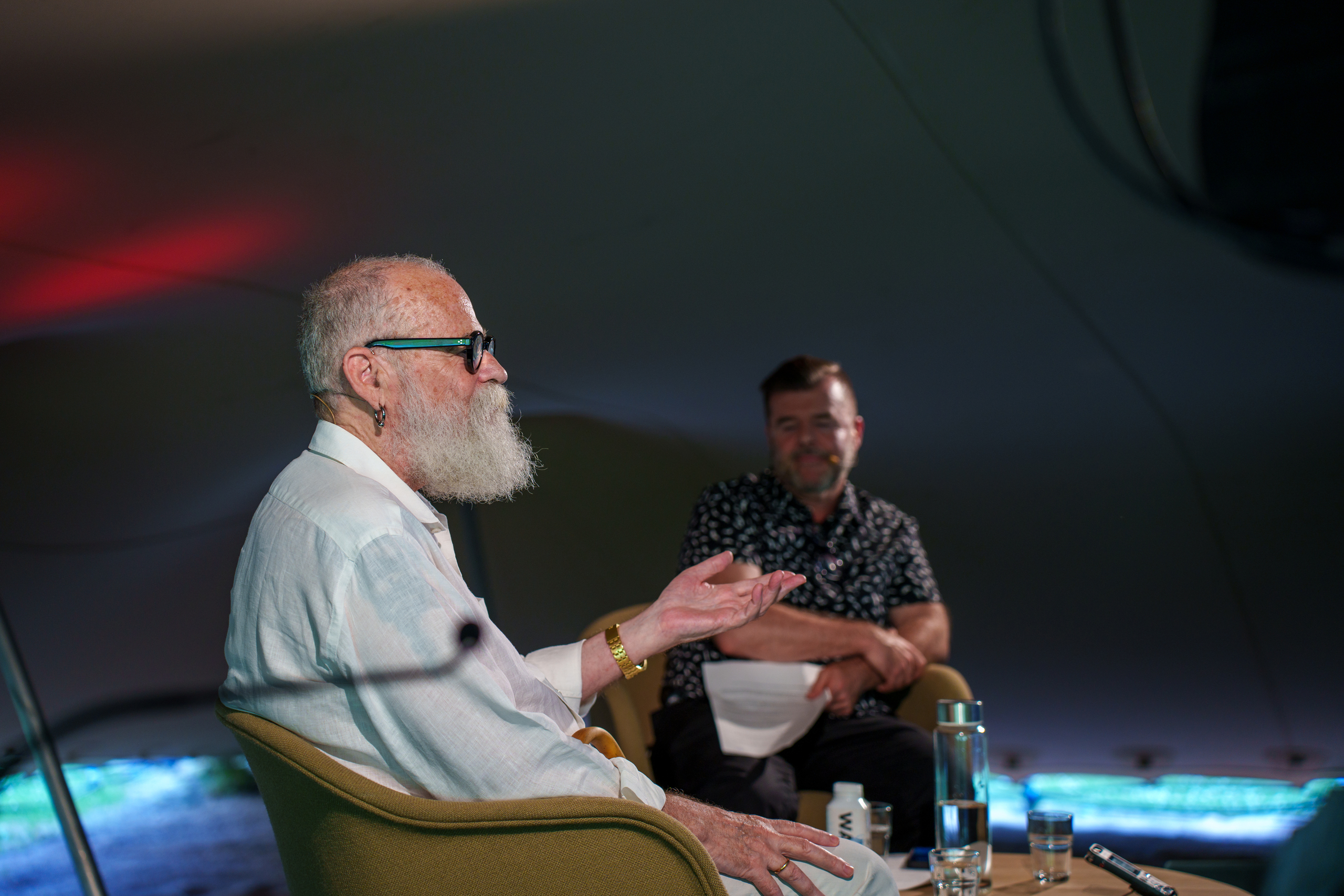
AA Bronson in conversation with Paul O’Neill. Presented by IMMA Talks & Pallas Projects/Studios, Thursday 25th June 2026, People’s Pavilion, IMMA. Courtesy of Pallas Projects & Irish Museum of Modern Art. Photo: Serhii Shapoval.
Bronson has penned numerous galvanising texts on artist-run practice, including ‘The Humiliation of the Bureaucrat: Artist-Run Centres as Museums by Artists’ (1983), which feverishly recalls the context in which Art Metropole was founded, amid a wave of countercultural enthusiasm and idealism: ‘we pooled our fantasies in the druggy waycharacteristic of the time to actualise our Burroughsian dream of a transcanada art scene’.[8] ‘The Transfiguration of the Bureaucrat’, written twenty-eight years later and after the death of his founding partners, takes a much more sombre tone. Structured as a series of diary entries, or perhaps emails, he registers the shift in arts practice in the intervening years: its rapid professionalisation, commercialisation, depersonalisation. Attending a conference, he notes, ‘All the speakers spoke as if anthropologists, their experience of both art and religion derived from secondary documents; as [his partner] Mark texted to me: “Is anyone speaking from the heart?”’[9]
Both texts influenced PP/S’s 2016 publication Artist-Run Europe: Practice/Projects/Spaces, to which Bronson contributed a follow-up, ‘Notes from Berlin’. And so, for its thirtieth anniversary year, PP/S invited him to Dublin for a live conversation with curator and educator Paul O’Neill, at IMMA on 25 June 2026. At the talk, Bronson spoke of his unorthodox entry into self-organising practice: dropping out of architecture school in Winnipeg in 1964; setting up an alternative education programme with fellow classmates, only for it to become overrun by teenage runaways; living in an early commune in Toronto. The community ethos this instilled would inform his work for decades. Taking over Printed Matter, New York, in the 2000s, Bronson managed to transform the cherished-but-struggling artist bookshop’s fate by welcoming zine launches. Though they generated negligible income, they placed Printed Matter at the heart of a flourishing DIY community, transforming it into something culturally vital – and thus viable. Though Bronson has since become a self-confessed pessimist, such stories are a testament to the power of community building and the potential rewards when artists overcome the odds to make it work, connect with one another, and just ‘do it’.[10] (O’Neill, himself an important carrier of the artist-run torch, is Director of PUBLICS, Helsinki – also part of the PP/S anniversary programme. His archive was acquired by IMMA in 2025.)
Another North Star of late-twentieth-century collectivism and artist-run practice is Gordon Matta-Clark, whose involvement with 112 Greene Street (c. 1970–74) and culinary experiment FOOD (1971–74), both in New York, were transformative. 112 Greene Street, founded by Jeffrey Lew with help from Matta-Clark and Alan Saret, had a twenty-four-hour opendoor policy and placed zero limits on expression or usage of the space. It quickly became a fertile site of experimentation, particularly for process-led practice, including Matta-Clark’s seminal Walls Paper (1972). The distressed, post-industrial context of the space itself, a former rag-picking building, became integral to the artworks displayed – the building was seen less as a container of objects, as a conventional gallery or museum might be, and more as raw material – or in Matta-Clark’s terminology, ‘ingredients’ – to be shaped.[11]
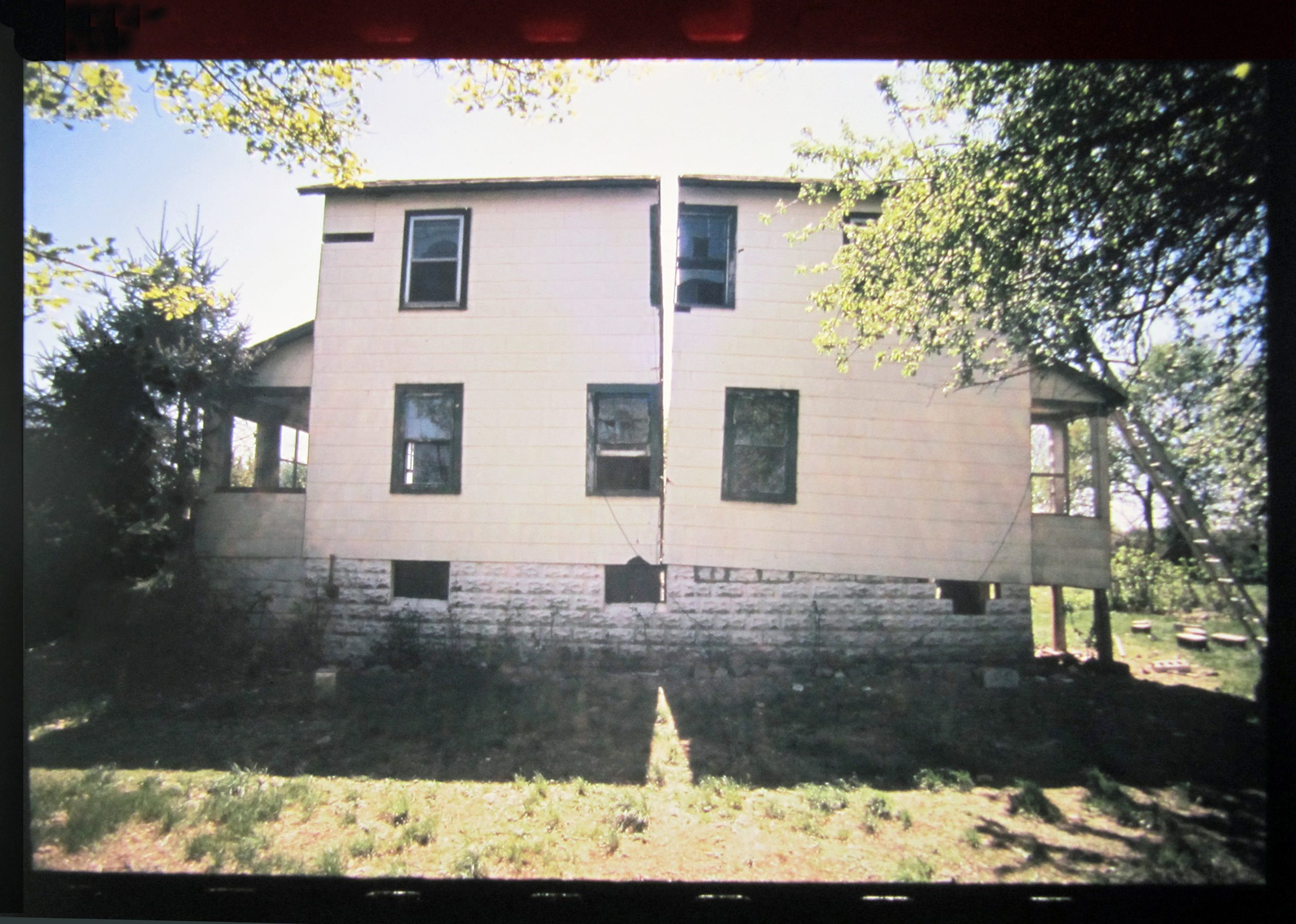
Gordon Matta-Clark, Splitting, 1974. Film still from Super 8 film. Courtesy of The Estate of Gordon Matta-Clark.
A vital ingredient to 112 Greene Street was the sociality it housed: a tight-knit milieu of artists and dancers, whose cooperative working style and mutual trust made the operation of such a boundaryless space viable (as, of course, did the comparative accessibility of ’70s New York real estate). Matta-Clark’s artistrun restaurant, food, meanwhile, put this social exchange at the centre of its philosophy. Founded in the Cast Iron District with fellow artists Carol Goodden and Tina Girouard, the eatery had a simple mission: to feed artists and give them a place to gather, socialise, offer mutual support, and find work.[12] Artists would work in the kitchen on a rotating basis, serving simple, modest dishes (the late architecture critic Herbert Muschamp’s arch observation was that ‘no one went to food for the food’).[13] The project was rooted in practicality, but also highlighted the precarity of art workers and the compromises often needed to make a practice economically viable. As Mark Cullen later wrote in Artist-Run Europe, ‘Artists engage in myriad jobs that enable them to continue their practice. We were chefs and builders at different times, others are teachers, invigilators, installers, administrators.’[14]
Matta-Clark passed away at a tragically young age of thirty-five. However, his life and work remain a touchstone for artistic practice and alternative ways of making and presenting work. He appears in PP/S’s thirty-year programme – most tangibly in the screening of three films, Splitting, Conical Intersect, and Day’s End, planned for their soon-to-be-launched space Pallas Open Projects (POP). But Matta-Clark’s presence will also be evoked by artist Jennie Moran, who has been invited to engage with the late artist’s archive and will take part in an in-conversation with Jessamyn Fiore (Director of the Estate of Gordon Matta-Clark). It’s an apposite pairing: Moran’s projects Luncheonette and How to Soften Corners are the spiritual descendants of Matta-Clark’s fruitful fusion of art and food, celebrating hospitality’s origin as ‘a mutual exchange between guest and host’,[15] but – I can attest – with much more palatable flavours.
****
That Matta-Clark and Bronson are both included in PP/S’s anniversary programme, then, is a clarion call to support collective ways of working. Their presence not only represents a vital link to the long and rich history of artist-run practice but establishes a conduit through which knowledge is passed down and histories are told. As with the publication of Artist-Run Europe when PP/S turned twenty, which demonstrated the depth and breadth of artist-run practice across the continent, the inclusion of Bronson and Matta-Clark drives home the message that no artist-run space exists in a vacuum. They also provide a compelling antidote to the toocommon idea that ‘there is no alternative’.
In addition to evoking these pioneers of artist-run practice, PP/S’s evolving exhibition, Do It Together, includes a plethora of contemporary practitioners who’ve taken up the baton. The experimental Belgian art space Kunsthal Gent, for example, contributes a sculpture in the form of a blue metal barrier titled Crisis of Masculinity, part of a collaborative artwork by Thomas Min and Egon Van Herreweghe. The work reconstructs the steel fence installed at Muscle Beach in Los Angeles – a waterfront outdoor gym touted as the birthplace of America’s obsession with male fitness, bodybuilding, and physical perfection. Cast adrift from flexed biceps and finely rehearsed clean and presses, the fence becomes an abstract sculpture – a barrier that restricts movement but allows the viewer to gaze through it. The ‘cut’ installed at PP/S is just one section of a much larger piece, made for Kunsthal Gent’s Endless Exhibition, ongoing since 2018. Over the course of that project, segments of the artwork have been dismantled and distributed to sculpture parks and private gardens around Europe – though its appearance in Do It Together marks its first voyage across water from the European mainland. Crisis of Masculinity’s inclusion therefore links PP/S not only to Kunsthal Gent, but various other spaces to which elements of the work have been distributed – operating like a node in a wider network.[16] In addition to this, Bagenalstown-based artist-run space Muine Bheag presents an installation including poster artwork, ephemera, and an audio work, while Helsinki-based publics showcases a curated selection of books, flyers, and printed and published material. Linking all these ‘nodes’ together is an ambitious, semi-permanent commission from the collaborative group Forerunner (Andreas Kindler von Knobloch, Tom Watt, and Tanad Aaron). Riffing on Moran’s work, the Matta-Clark archive, and Kunsthal Gent’s sculptural contribution, the trio make architectural interventions to the space itself, and create custom exhibition architecture for the invited projects and spaces.
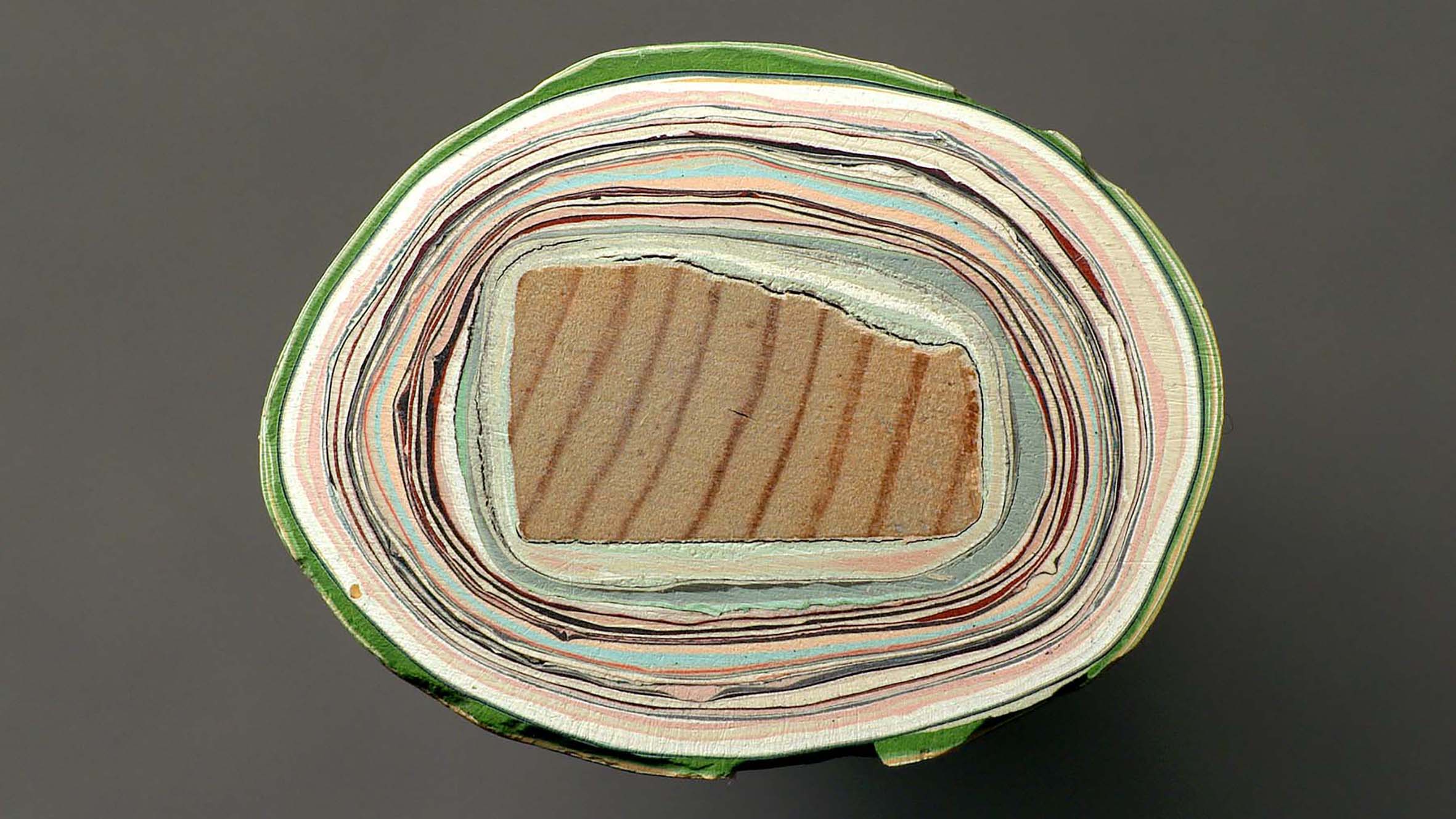
John Smith, Dad’s Stick, 2012. HD video, 5 minutes. Commissioned by Frieze Foundation for Frieze Film.
If Do It Together unites disparate geographies, it also collapses time on itself, conjuring a number of iconic moments from PP/S history. The early days in the knitwear factory are evoked by Katie Holten and Brian Duggan – part of a core group of early Pallas artists, but still active and acclaimed practitioners. Jesse Jones and Brendan Earley revive the Pallas Heights era, Jones showing On the Waterfront, Sarah Browne and Gareth Kennedy link us to Pallas Contemporary Projects, while the pivotal year on Dominick Street is evoked by John Smith, who returns to present Dad’s Stick (2012), a film meditating on his relationship with his late father.
Then there are new generations of artists, who have since joined the fold: in 2012, the New York duo E.S.P. TV (Scott Kiernan and Victoria Keddie) made a live transmission from PP/S’s then-new space in the Coombe; a year later Ruth Clinton and Niamh Moriarty made their first collaborative public presentation, ROTATOR: both will be reprised. More recently, Venus Patel participated in PP/S’s Artist-Initiated Projects series (2023); the work she presented has since been shown at IMMA. Another unearthed gem of the Artist-Initiated programme is Robert Dunne, whose sculptural practice, evolved away from the Dublin art scene in Kilkenny, is a testament to the potential yields reaped by open call. The programme rounds off with film screenings by Hito Steyerl, continuing the trilogy of artist films kicked off at Pallas Contemporary Projects and continued at Dorm.
Thirty years of operation means that what started as a peer group in 1996 is now a cross-generational site of exchange. PP/S continues to support early-career practice, providing a vital link between art colleges and institutions by offering many artists their first shows. With that in mind, as pointed out by Gavin Murphy in Artist-Run Europe, it’s important that artist-run spaces resist the urge to ‘grow up’ into institutions – to professionalise where necessary to ensure their continued existence, but to retain the grassroots DIY ethos that made them start up in the first place.[17] As AA Bronson has put it, ‘The true artists among us are those travelling invisibly beneath the bureaucratic radar … Theirs is a practice of exchange, of community, a creative formation of culture, the culture that binds them to each other, on a daily basis.’[18]
Rosa Abbott is a curator and writer based in London. She is currently Assistant Curator at the Design Museum, London.
Notes
[1] Co-Director Gavin Murphy has written, ‘The ability to transform is at the core of artistic practice and it is this chameleon-like virtue that has allowed Pallas Studios to change and transform itself as the geography of north inner-city Dublin has changed dramatically around it.’ Gavin Murphy, By Diverse Means We Arrive at the Same End (Dublin: Pallas Studios, 2006), 2–3.
[2] Mark Cullen, ‘Zones of Contention – Two Decades in the Life of Pallas’, Artist-Run Europe: Practice/Projects/Spaces, 2nd edition (Eindhoven: Set Margins, 2023), 57.
[3] Press release, Salon 99, November 1999; https://pallasprojects.org/ projects/salon-99, accessed 28 July 2026.
[4] Paul McAree, ‘Sea of Unknowing’, in Pallas Heights 2003–2006, eds. Brian Duggan and Mark Cullen (Dublin: Pallas Publishing, 2007), 101.
[5] James Merrigan, ‘The Body Aesthetic’, published on the occasion of Periodical Review ‘X’, December 2020; https://prx.pallasprojects. org/, accessed 17 September 2026.
[6] Eric Banks, ‘Art Metropole’, Artforum, January 2005; https://www.artforum.com/ columns/art-metropole-170541/, accessed 30 July 2026.
[7] Sarah Schulman, ‘The Gentrification of AIDS’, Gentrification of the Mind: Witness to a Lost Imagination (Berkeley, LA: University of California Press, 2012), 36–53.
[8] AA Bronson, ‘The Humiliation of the Bureaucrat: Artist-Run Centres as Museums by Artists’, first published in Museums by Artists, eds. AA Bronson and Peggy Gale (Toronto: Art Metropole, 1983), 29–37; https://ngcr.utppublishing.com/doi/full/10.3138/ngcr.12003, accessed 27 June 2026.
[9] AA Bronson, ‘The Transfiguration of the Bureaucrat’, ArcPost; https:// arcpost.ca/articles/the-transfiguration-of-the-bureaucrat, accessed 27 June 2026.
[10] AA Bronson in conversation with Paul O’Neill, recording from talk at Irish Museum of Modern Art on 25 June 2026.
[11] Tina Girouard, quoted in Sandra Zalman, ‘112 Greene Street as Site’, in Walls Paper 1972 by Gordon Matta-Clark, Tate Research Publication, 2017; https://www. tate.org.uk/research/in-focus/ walls-paper/112-greene-street, accessed 27 June 2026.
[12] Sandra Zalman, ‘Eat, Live, Work’, Walls Paper 1972 by Gordon Matta-Clark, Tate Research Publication, 2017; https://www.tate.org.uk/ research/in-focus/walls-paper/ eat-live-work, accessed 30 July 2026.
[13] Herbert Muschamp, ‘Thought for Food’, Artforum, May 1998; https:// www.artforum.com/columns/ gordon-matta-clark-2-201496, accessed 30 July 2026.
[14] Cullen, ‘Zones of Contention – Two Decades in the Life of Pallas’, Artist-Run Europe, 59.
[15] Jennie Moran, ‘How to Soften Corners: Jennie Moran’s Philosophy of Hospitality’, RTÉ Culture, 28 April 2024; https://www.rte.ie/ culture/2024/0427/1445027-howto-soften-corners-jennie-moransphilosophy-of-hospitality/, accessed 30 July 2026.
[16] Michel Foucault wrote that ‘the frontiers of a book are never clear-cut: beyond the title, the first lines, and the last full stop, beyond its internal configuration and its autonomous form, it is caught up in a system of references to other books, other texts, other sentences: it is a node within a network.’ This idea is important to PP/S: the quote is used to introduce each edition of Periodical Review. Michel Foucault, The Archaeology of Knowledge, trans. A. M. Sheridan Smith (London: Routledge, 1989), 25–26.
[17] Murphy, ‘What Makes Artist-Run Spaces Different?’, Artist-Run Europe, 4–17.
[18] Bronson, ‘Transfiguration of the Bureaucrat’.