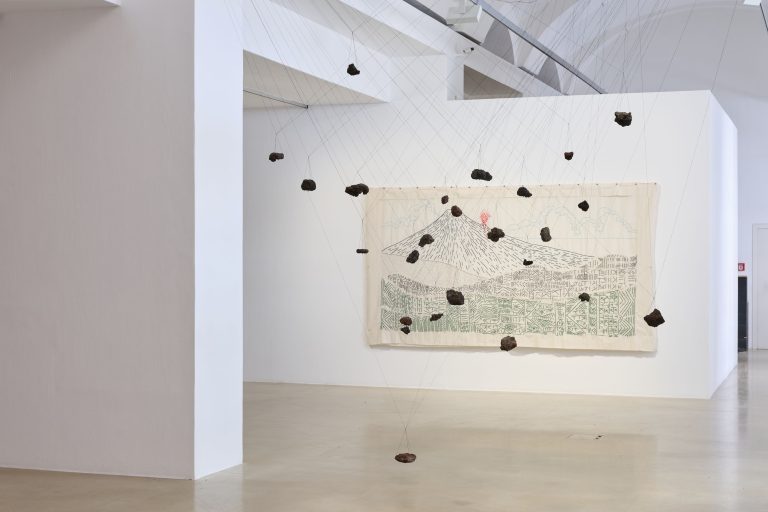
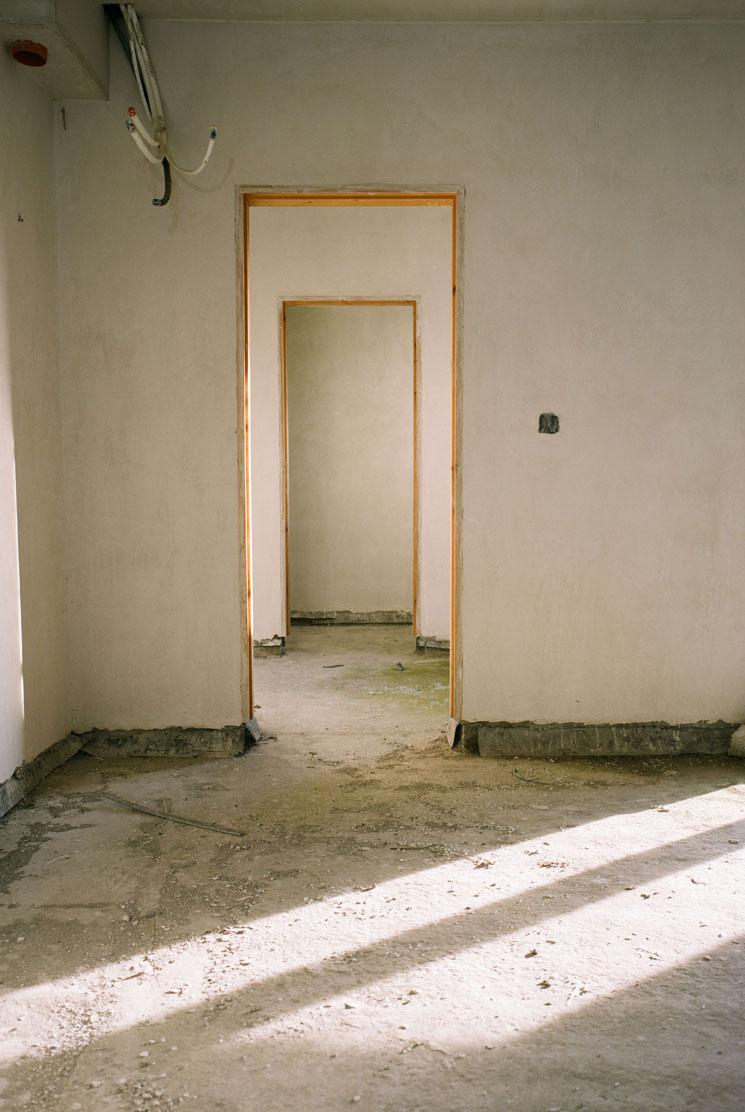
Ciarán Ó Dochartaigh’s solo exhibition at Project Arts Centre takes its title from an NHS Clinic he attended while in search of a diagnosis for a range of symptoms including weight loss, night sweats, fatigue, and brain fog. Sickness often forces the pathologised subject to engage with these mechanisations of the state in an attempt to receive the diagnosis that provides the evidence the state requires to treat said subject. Therefore, those undergoing a protracted diagnostic process are often extremely cognisant of the biopolitical interface between state and subject, and the particularities of state violence and how that can be enacted on communities of interest. A native of Derry, Ó Dochartaigh considers both the processes of a personal diagnosis and medical treatment by the state as well as the parallel violence that state deploys through occupation, partition, and architecture as a means of controlling populations. In Vague Symptom Clinic, these concerns around diagnosis, medicine, and state violence are explored through a broad set of sculptural mediums with a surprisingly humorous effect.
Ciarán Ó Dochartaigh, Vague Symptom Clinic, Project Arts Centre. Photo: Louis Haugh.
The gallery space is divided by a partition wall, creating a corridor leading to the main section of the exhibition. The corridor is a mock facade of Rossville Flats in Derry, which were built in the 1960s for Catholic families displaced by redevelopment. This facade is intersected by three holes in the shape of a cellular cross section, allowing you to peer into the space on the other side. Some of these holes are bordered by mirrors, with mucosal glass sculptures leaking out with flapping medical tubing emerging from others. On the opposite wall of the corridor, the artist has used a found object – a creamy rounded plastic hospital handrail – which implies a sense of regulated movement. Before turning into the main exhibition space, you can see a white neon signal spelling out VAGUE SYMPTOM CLINIC in all caps sits high on the perpendicular wall with the whining exertions of pumps and pistons audial on the other side.
Ciarán Ó Dochartaigh, Vague Symptom Clinic, Project Arts Centre. Photo: Louis Haugh.
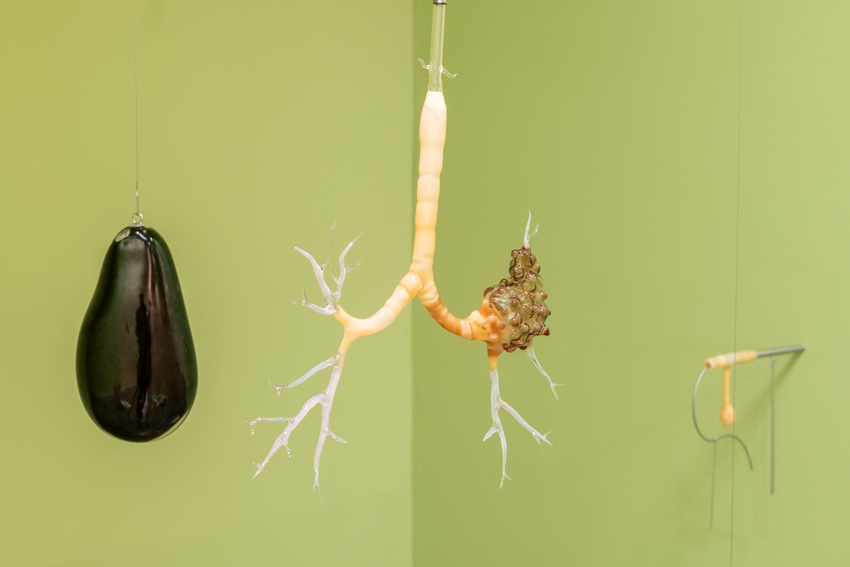
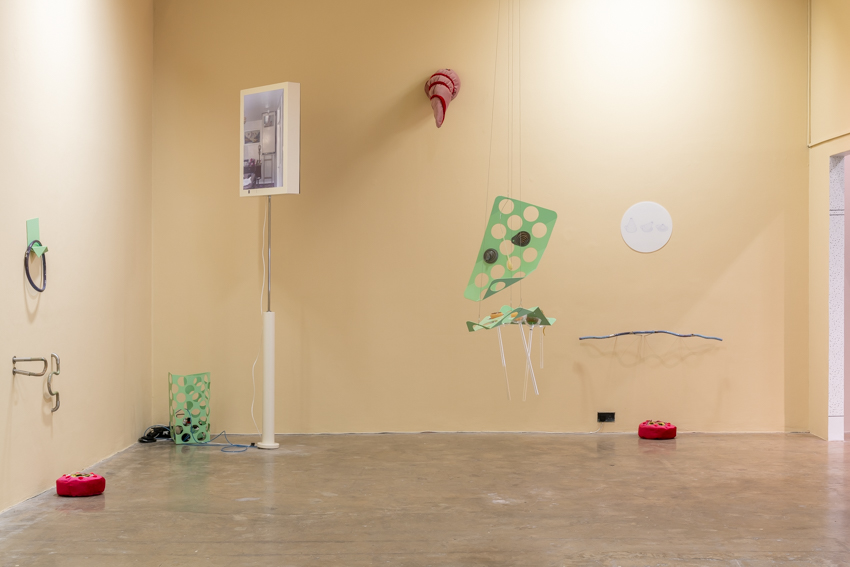
The main exhibition space – or clinic – is painted in a green and yellowy magnolia colourway. With objects suspended from the ceiling, hanging on the walls, and lying on the floor, some spinning, pumping, or producing mechanical noises, the exhibition, at first, felt heavy-handed, sucking the air out of the room with its claustrophobic density. The floor was occupied by these plushy blood red and pink cones, akin to primordial cannolis expelling pistachio-green slime from their mouths. Twisted and popped blister packs are scattered across the floor and suspended mid-air, as if a pill-popping giant desperately seeking relief had rushed through the room moments before. The wall is lined by unusable, undulating, and partly broken ceramic handrails. An intricate blown glass sculpture of the respiratory system hangs near the back of the room with a cartilage white trachea, baby blue bronchi, and a large brown tumour growing across its left side. Throughout the space, blown glass sections of the respiratory system and chunks of mucus are held in place using medical grab stainless steel devices as if specimens ready for dissection – some in healthy greens and off-whites, while others are speckled with thick reds and tar brown.
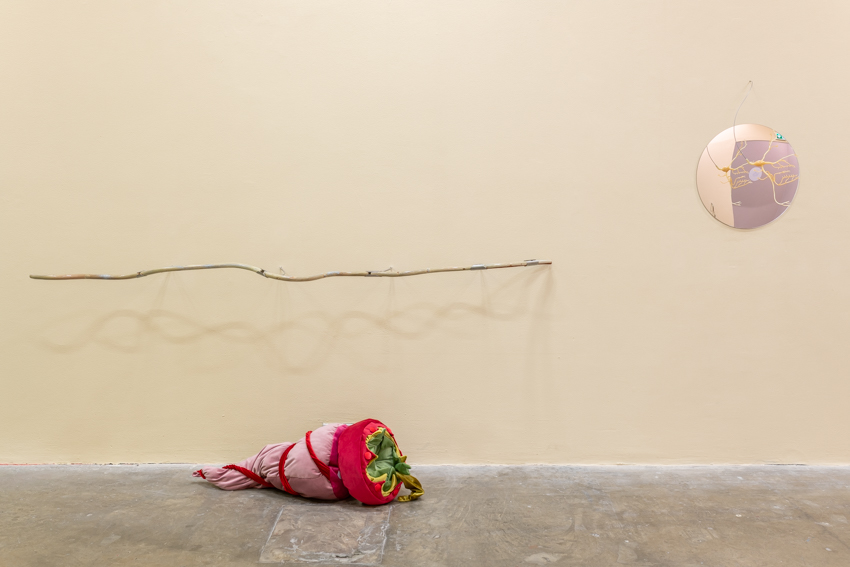
Ciarán Ó Dochartaigh, Vague Symptom Clinic, Project Arts Centre. Photo: Louis Haugh.
Although many of these plushy sculptures, floating lumps of phlegm, broken handrails, and neon signs touch on experiences of personal loss of family members and chronic illness, the responding effect was of the absurd, which brings us back to Rossville Flats. A largely black on white drawing of Rossville Flats akin to an architectural plan is displayed on a light box, the corner of which features a row of two-storey terraced houses. A thought bubble appears above the terrace – as if zooming inside of one of the houses – featuring a drawing of an older woman with glasses using a mobility lift. The woman in question is Ó Dochartaigh’s granny, who lived in one of these houses in the Rossville estate and used a lift to move between the two floors. The drawing of Rossville is demarcated by a red line – interlaced with arrows pointing in the same direction – winding itself through the three blocks of the main Rossville estate, revealing the farcical step-free route she was forced to take to avoid stairs and access street level. Another thought bubble zooms near the entrance to the passageway on his granny’s step-free route, revealing graffiti stating ‘H. M. Prison Rossville’. A commentary on the overcrowded and over-policed conditions in Rossville, and also the architectural barriers Ó Dochartaigh’s granny faced.
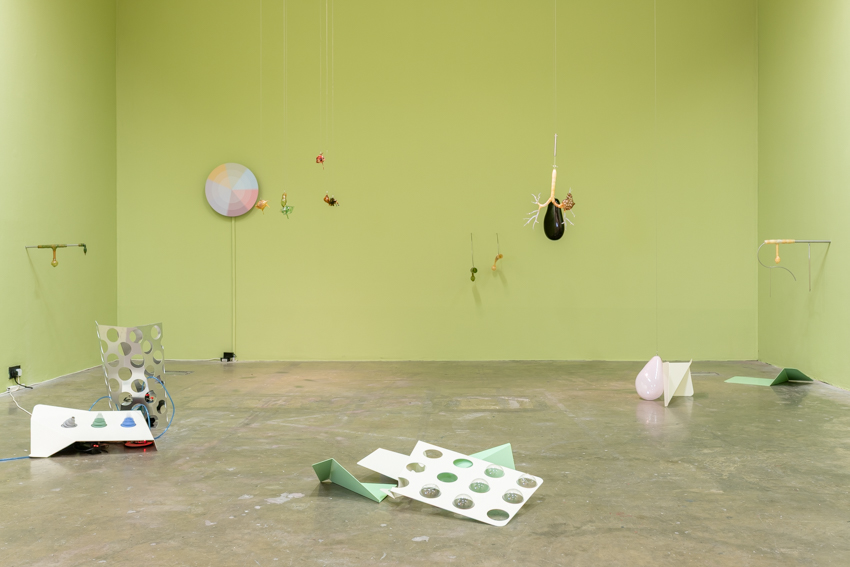
Ciarán Ó Dochartaigh, Vague Symptom Clinic, Project Arts Centre. Photo: Louis Haugh.
Ó Dochartaigh riffs off this absurdity by installing another light box with a photograph of his granny in the mobility lift on her way either up to the first floor or descending down into the dining room, seen behind the glass in a floral shirt, smiling. Aping the mobility lift, the light box ascends and falls on a piston at random intervals as a risible memorial to a loved one and the imaginative ways we are asked to traverse the world. At the same moment the pistons of the light box would activate, other haptic devices in the space begin their chorus, including douche-like silicone pistons in pastel grey, green, and blue, the head of which is pushed out, and then they fold in on themselves mimicking the sounds of a medical ventilator as they themselves gasp for air.

Ciarán Ó Dochartaigh, Vague Symptom Clinic, Project Arts Centre. Photo: Louis Haugh.
Ó Dochartaigh has made a body of work full of evocative disorder that sits on the intersection of the mournful and the absurd all too familiar to the chronically ill and disabled, especially in the compromises we make to placate a fickle state in search of diagnosis and associated medical care. At the same time, he is acutely aware that the state is no saviour, and the biopolitical power it deploys to manage our health is also used to surveil and police suspect populations. As the state is a fiction repeated into existence, a diagnosis is just another story we tell to get what we need. And in the search for his, Ó Dochartaigh writes comedy gold.
Iarlaith Ní Fheorais is is a curator and writer. She was the curator of the twenty-first edition of TULCA Festival of Visual Arts and has written for publications such as frieze magazine, Burlington Contemporary, Viscose Journal, Girls Like Us, and Paper Visual Art. Ní Fheorais has a forthcoming book on the MedTech industry in Ireland commissioned by Askeaton Contemporary Arts.