paper visual art journal

Michelle Deignan: Posing as a Subject Amongst Subjects, Maria Stenfors Gallery, London, 16 September – 29 October, 2011.

22.12.2011 (12:57 am) – Filed under: Reviews ::

Posing as a Subject Amongst Subjects is Michelle Deignan’s first solo exhibition at Maria Stenfors Gallery in London. The title ventures a hint of for how to enact the role of viewer in this exhibition, and suggests the inter-subjectivity that is at play in this presentation of photography, film and digital video works.

On the wall opposite the entrance to the gallery are two framed C-type prints, titled Tuesday Blooms. They depict cherry blossoms in full flush, vivid against a blue sky. These images have a deliberate element of the casual snapshot in their execution, suggested by their modest scale and their closely cropped format.

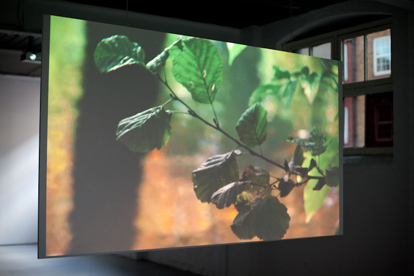
mdbk5Michelle Deignan: Journey to an Absolute Vantage Point, installation view, 2009, 2 channel HD video installation, 6 min 13 sec loop; Image courtesy Maria Stenfors Gallery.

Behind, there is the familiar whirring sound of a 16mm film projector that serves to conjure a sense of nostalgia associated with the home movie. This Super-8 film, transferred to 16mm is also titled Tuesday Blooms. It is projected in a small, intimate format on the wall, and like the photographs nearby, depicts cherry blossom trees in full bloom.

Occasionally, a figure appears within the frame, in the act of capturing the blossoms on a hand-held camera. This self-reflexive depiction of a subject in the act of representation ruptures the immersive effect of the projection. It reminds the viewer that we are precisely that; observers in the act of observing. The subject in the film appears so involved in his own activity of recording that he is unaware of the gaze of another. The C-type prints Tuesday Blooms that hang nearby suggest the possibility that these could be the output of the subject within the film.

From the way the projector is placed on a plinth it is possible to observe the tiny frames of the film as they pass through the machinery of the projector; the blossoms pass by in minutae. These flowers are at the peak of their glory, on the cusp of the point at which they will wilt and die away. Here in this recording they are preserved in celluloid, remaining forever in bloom and impervious to the seasons.

mdbk2Michelle Deignan: Tuesday Blooms, installation view, 2011, 16mm film, projector; Image courtesy Maria Stenfors Gallery.

These two works examine amateur film and photography and what they signify. On one hand they are documenting and preserving a moment for posterity. Yet the presence of the photographer within the film creates an awareness of the selectiveness of this imagery, a reminder that these images are not passive in their observations.

Around a small divide appears an alcove where two framed Lambda prints hang. Descriptively and simply titled, Violin depicts a violinist in a recording studio, Microphone a woman in the process of recording a script. Blurred in parts, with their subjects in motion, these lambda prints read more like film stills than photographs. Both indicate the process of interpretation and representation, of subjecthood found within the relating of a musical score or a written script.

mdbk3Michelle Deignan: Microphone, 2008, unique lambda print, 46 x 61cm; Image courtesy Maria Stenfors Gallery.

Nearby, bisecting the space is a 2 channel HD video installation titled Journey to an Absolute Vantage Point. On one side of the screen appears a recording of a commissioned piece of music by three performers; a pianist, cellist, and violinist. On the other side of the screen a film depicts panoramic scenes from the Schloss Charlottenburg and gardens in Berlin.

The accompanying voiceover is in English, by a German actress and describes the meeting of a man and a woman in the grounds of the Schloss. The two protagonists’ discussion begins tentatively, the motivation for their meeting remains a mystery to us, but seems to be a source of anxiety for them. Their exchange in the most part seems innocuous, variously discussing Beethoven and Casper David Friederich.

As the musical score swells to a crescendo from the opposite side of the screen, so too does mood of the protagonists’ exchange. An argument breaks out: “What are you doing? You deliberately shifted the discussion…I could accept it if it was clear that we just had different opinions, different viewpoints of the same subject.” At the same time the film depicts a lake where two camera wielding interlopers doggedly photograph the film-maker in the act of filming. The spell is broken, and the narrator repeats the opening dialogue again, as if nothing has happened.

mdbk4 Michelle Deignan: Journey to an absolute vantage point, installation view, 2009, 2 channel HD video installation, 6 min 13 sec loop; Image courtesy Maria Stenfors Gallery.

Journey to an Absolute Vantage Point is a deconstruction, laying bare the various collaborating cinematic components of voiceover, musical score and cinematography. Deignan alternates between using these devices in concert, to utilising them to rupture the cinematic artifice. The artist makes visible that which is normally hidden by filming the performance of the score by the musicians. Meanwhile the voice of the narrator ensures that as viewers we are kept at a distance from the subjects. They remain invisible; they are never visually represented in the film and their words are spoken and interpreted by another.

Throughout this exhibition, the viewer is reminded to consider the construction of what is presented, the nature of the exhibitions’ individual parts, and our agency in the work as a whole. Our subjecthood within this dialogical matrix is never far away, the artworks don’t allow it. As the title opined from the start, we are reminded that we are acting as a subject among subjects.


Barbara Knezevic is an artist who lives and works in Dublin.

Oneiriography: The Green on Red Gallery, 3 June – 10 July, 2010.

12.07.2010 (11:35 am) – Filed under: Reviews ::

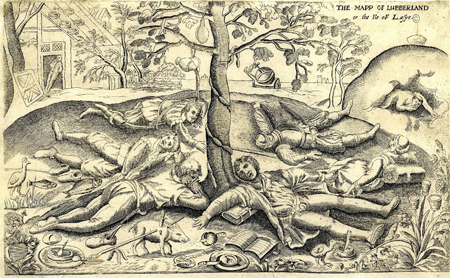
BloorSimon & Tom Bloor: Anonymous, Mapp of Lubberland (Research image), Engraving print, circa 1670, image courtesy the Green on Red.

The latest show at the Green on Red Gallery, curated by Chris Fite-Wassilak, concerns itself most emphatically with memory and the failure of the present to come to terms with things lost. Sparsely installed in the space is the work of Simon and Tom Bloor, Ruth Ewan and Michelle Deignan. Outside, we hear the monotonous drone of a sound piece by Ragnar Kjartansson, accompanied by documentary photographs, and some small-scale watercolours.

Simon and Tom Bloor’s work is most synonymous with the kind of temporal preoccupation that pervaded the exhibition. Resistance Through Rituals (2010) takes the form of large-scale black-and-white photographs pasted abruptly onto a backdrop of streaky white emulsion. Billboards came to mind, specifically those as they fade away and denigrate pathetically over time. Depicted in these images are children playing, but caught in such a way as to render them static, immobile. A certain athleticism is connoted, a kind of youthful vigor which finds satisfaction by and for its own means. However, the utopian ideal of childhood is quite literally stopped in its tracks with these children appearing poignantly powerless and trapped. In most cases, the images appeal to us; the children seem to be playing ‘up’ for us, showing off or performing. This places us in a position of responsibility; the echo of propaganda in these images undermines the utopian ideal of childhood. Resistance Through Rituals becomes a hazy construct. The ritual-as-resistance, recalling Georges Bataille, becomes a growingly problematic domain.

DeignanMichelle Deignan: Journey to an absolute vantage point (2009), two channel video, edition of 3, image courtesy the Green on Red.

The failure of the present to deal with the conditions of the past is also a concern of the work of Ruth Ewan. Probably most well known for her 2007 work Did You Kiss the Foot that Kicked You? which involved commissioning one hundred buskers to perform a 1960s protest song on the streets of London, Ewan grapples with the recent past and the reliability of its manifestation in a startlingly amnesiac present. The Brank: The Damnation of Memory (2010) takes the form of a silently projected slide show and a glass table within which are presented postcards – to see the front of them we must peer awkwardly under the table. What we are presented with is places – the Netherlands, Houston, Salem and Finland – sometimes directly connected with witchcraft, often simply providing a temporary setting for the West End musical Wicked. The slide show continues in this vein, casually interspersing pop-culture depictions of witches alongside family snaps and medieval prints capturing scenes of abject torture. The personal and the objective historical cross paths and come to undermine one other. Thus, we recognize once again the sanitized myth that the witch has become, and the ramifications of this on the actual lived reality of history.

Michelle Deignan’s intriguing video piece, Journey to an Absolute Vantage Point (2009), takes the form of two channels projected on either side of a large screen, bisecting the gallery space. Both channels compete for our ears, the sound of a specifically commissioned tango piece threatening to overshadow our perception of a female monologue recounting a particularly dramatic encounter between her and a male companion. Footage of the idyllic grounds of a castle in Berlin echoes her monologue as she recounts their conversation which happened to take place there. As harmony breaks down, so too the reciprocal relation between sound and image. No longer referential, the image breaks down, moves away and grows more abstract. In doing so, reliability breaks down also. The conversation, resembling a kind of highbrow rambling Tarantino fare, becomes preposterous – “you haven’t revealed anything – nothing!” The hysteria of the conversation situates itself completely at odds with the pastoral setting of the video, and in doing so throws its naturalness into question. As the female protagonist states at one stage: “Focus can be so personal, so random.” The video of the tango musicians reiterates this also; personal history is depicted as interpretation, and history more generally is filtered through a process of de-naturalization.

more »