paper visual art journal

Q & A | Brendan Earley: A Place Between, Royal Hibernian Academy (R.H.A), Dublin, 5 March – 29 April, 2012.

21.05.2012 (11:08 pm) – Filed under: Essays / Articles ::

A Q&A between Brendan Earley & Pádraic E. Moore following A Place Between at the RHA Gallery Dublin, 5 March – 29 April, 2012.

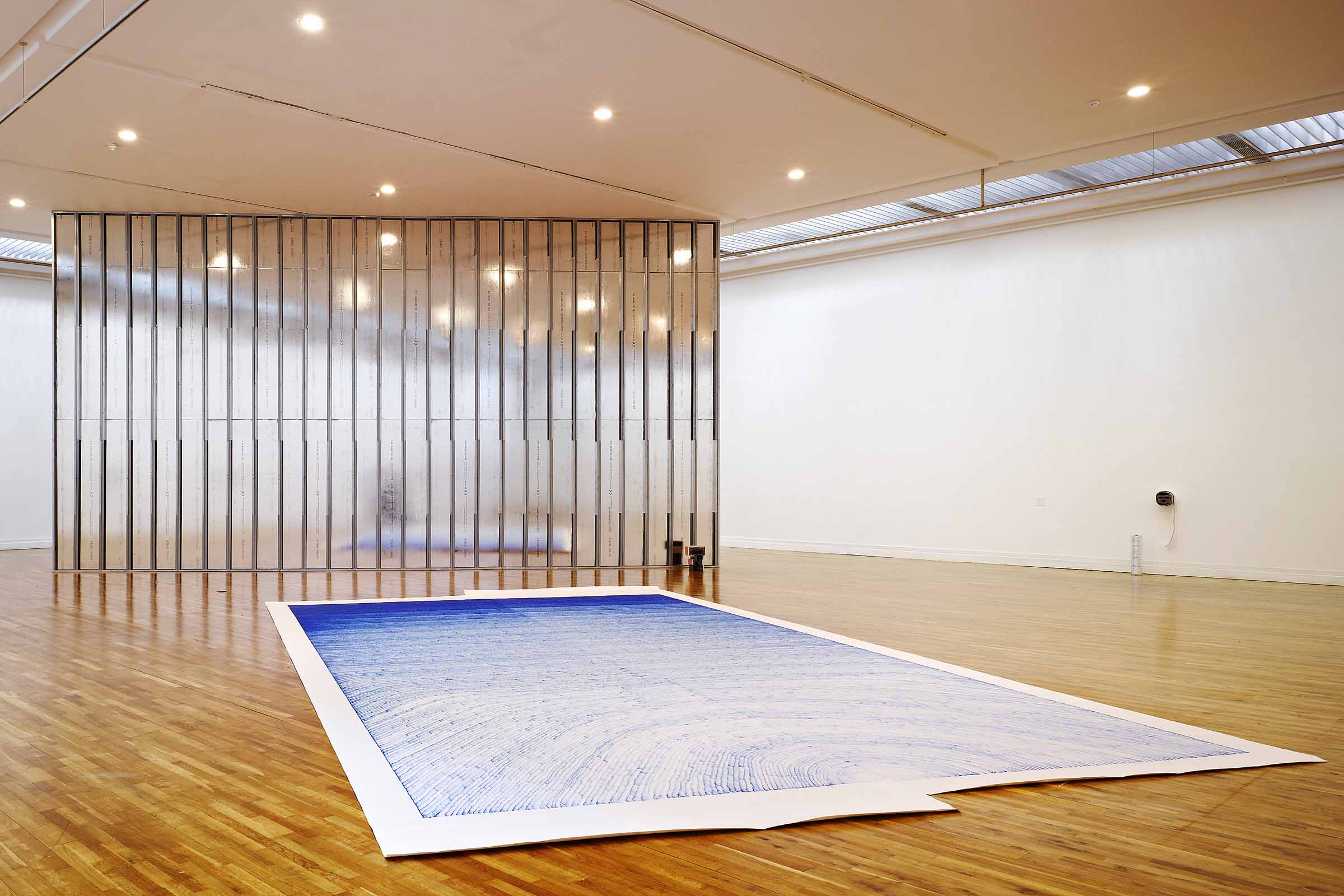
Brendan Earley: A Place Between, 2011-12 Felt tipped pen on paper. 9x5m.
Brendan Earley: A Place Between (2011-12), felt tipped pen on paper, 9×5m; Image courtesy the artist and mother’s tankstation.

Q1: The title of this exhibition evokes hinterlands, and perhaps even the abandoned building sites that characterise Dublin and other urbanised locations throughout Ireland at present. Does this preoccupation with transitional landscapes emerge from a desire to explore the possibility within uncertainty – and I don’t refer only to the current climate of economic uncertainty.

A: Well, from what I remember the title came out of a conversation with Pat Murphy (the Director of the R.H.A. Gallery, Dublin) early on in our discussions about what the show was going to look like. In the beginning there was going to be a lot more walls built, with a heavy emphasis on wandering around the gallery, but then I felt this was a little too contrived.

Apart from the obvious attraction one might have for ‘out of bounds’ areas found in places like the hinterlands of a city, the real interest I find is in their liminality. These are in-between spaces which naturally appear in cities and would happen anyway regardless of our obvious economic crisis. They lie idle and overgrown and in a semi-bucolic state, seeming to wait for something.  These places invite me in, not like a trespasser, but more like a visitor.  I think these places have a quality which stems from the fact that the labels ‘urban’ and ‘rural’ with which we normally find our bearings in a landscape do not apply.  It’s not the fields of farms but the Grand Canal beside my studio in Inchicore that are thick with wild flowers every year, for me this points to the ability of wildlife to survive in these waste lands. I really find this remarkable, nature’s persistence in the face of ceaseless change in urban areas. This gives me great hope too because I find it a bleak view to see the story of man/nature as nothing more then one of survival, with nature irrevocably opposed to man, forever just holding on. So looking at it in a more hopeful way, it is a story of co-existence, of how it is possible for the natural world to live alongside man, even in places destroyed because of our excess and greed. So for these reasons I have taken a more active interest in the possibility found in a built environment under a slow change, one that accepts uncertainty in order to develop organically.

Brendan Earley: Hunky Dory, 2010 Pen on photocopy and coloured paper. 29.5x20cm
Brendan Earley: Hunky Dory (2010), pen on photocopy and coloured paper, 29.5×20cm; Image courtesy the artist and mother’s tankstation.

Q2: This exhibition evinces a shift in your practice in several ways.  In particular, some of the drawings include figures and you have begun to use colour in an almost expressive manner. I was interested to note that you had given these works names that referred – quite specifically – to song titles. There is also clearly a reference to Tarkovsky’s films. Can you give some insights into this?

A: I think finding fragments of things on my way to or from work and reuniting them in some way has always been a central preoccupation in my work. Lines from songs that one would hear have a similar feel to the detritus I use to begin a sculpture and they (the songs) would finish them. Indeed with this show, collage became important as it provided a handy antidote to my fear of the blank page (the large marker drawings are another way out) and they also allowed me to use colour in a looser way. As well as all sorts of other bits of ephemera which I find in those large DIY stores found on the periphery of cities.

Figures have begun to appear in the drawings mostly because I decided to make my interest in certain histories more explicit, such as land art, science fiction and the Romantic tradition. This can be seen as a way of mourning the devaluation of these histories (and in particular the latter), ways of seeing that I can never have. Artists who once, with fresh eyes, discovered sublime nature as a mirror of their soul and whose discovery is now obsolete. Hunky Dory is taken from an image of Robert Morris standing in front of one of his steam sculpture/environments. So the figures, although masked or half hidden belong to the past, but inhabit the present with me as ‘ghosts’. A bit like the shadows found in the reflections of the big wall.

This large structure was built for a number of reasons, as a screen hiding the large blue drawing (A Place Between) as you came into the main space. It also confronted you as a barrier would giving as little as possible away. But one of the great things with the silver foil faced on the far side was that it disappeared into the fabric of the building once you walked around to view it from the other side. Thereby turning the wall from something which kept you out to something which let you in. In some way I think you entered the gallery twice as your reflection in the mirrored surface of the wall actually placed you in the landscape of the exhibition. This inclusion marks a change in my practice, from drawings and objects and their potential relationship to debates in architecture and history, to a deeper need to understand the cost of progress in our built environment.

These concerns are beautifully voiced in Tarkovsky’s Stalker, a glacial slow, almost event free film about landscape and longing. This is a film which lingers for long minutes over broken wastelands of abandoned industry encapsulating Tarkovsky’s interest in dereliction and decay, imbuing these broken landscapes with a terrible sense of threat. Largely unable to realise the alien properties of artifacts found in the book the film is based on, Tarkovsky projected the danger into architecture itself. Passive landscapes that could swallow a man. Tunnels which tear them to shreds. These effects were never demonstrated, but also never doubted, thanks to the tentative way actors explore their surroundings.

Brendan Earley: Wall (2012), silver backed plaster board and alumnium, 9x5m.
Brendan Earley: Wall (2012), silver backed plaster board and aluminium, 9×5m; Image courtesy the artist and mother’s tankstation.

Q3: In many ways you might be considered a landscape artist and you have referred to yourself as this in the past.  This exhibition might itself be read as a kind of sprawling landscape that occupies the gallery space.  You obscure a view of the gallery so one must explore and investigate. You are surely interested in the idea that a viewer or visitor to the space has to negotiate the space and indeed, discover facets of the show for themselves?

A: I suppose the main paradigm I was taught was installation art – so all my work is considered in terms of the viewer’s role in relation to meaning found in the work, being an observer who ratifies the contract to allow meaning to appear. However this comes with certain conditions; it is not a passive role. Indeed this position runs parallel to me wondering what a contemporary landscape artist entails, if there is such a thing. I do feel we can no longer be the figure in a red coat resting on the stile as in 18th and 19th century Irish landscapes. As we pass through this land we most be more conscious, “to wander with purpose” as John Hutchinson (director of the Douglas Hyde Gallery, Dublin) would put it. This sort of consciousness involves merger, or identification with one’s surroundings. Its antithesis, rational consciousness – the sort that produces Styrofoam and IKEA flat packs – requires a total separation from any sort of merger with nature. Subject and object are always seen in opposition to each other. I am not my experiences, and so not really a part of the world around me. I am afraid the logical point of this world view is a feeling of total reification as Marx would point out: everything is an object, alien, not-me; an alienated thing in a world of other, equally meaningless things. Depressing, but I suspect it to be true, in some sort of way, of this rational ideology.

Q4: Your work evinces an interest with introducing abandoned detritus from the outside world into the studio and eventually the gallery. This process involves navigating the landscape near your home and studio in order to discover the rejectementa of society. Found components become integral to finished works. In many case, it seems that there is an almost alchemical process involved in your work. The found object is merely a starting point.

A: Yes, there is definitely a very real transformation in the objects, nothing is what it seems. The light Styrofoam becomes incredibly heavy once it’s cast into aluminum or bronze in the foundry, for instance A Million Years Later is well over 100 kg. For me the great thing about sculpture as I understand it is its power to reclaim objects for purpose. Not necessarily for a purpose but to give them an integrity, a weight if you pardon the pun. I don’t really see it as recycling, I am far too selective for that and I think for recycling to work one can’t be selective, but because I am driven by a desire to find purpose for the most trivial things I feel my wanderings are not in vain. Perhaps this is why I am driven to take even the most abject things such as a burnt bin I found outside my studio – it became the sculpture Solaris in the end. Again, like the Romantics of the nineteenth century, I would favour an open process and the fragmentary over systematic and concise, in order to be able to adjust the mind to a contradictory reality, rather then the other way around.

The only danger is this approach could be construed as some sort of romance with entropy. The places I visit are in no way a substitute for the official countryside and not to be cherished in their own right necessarily. I don’t want my work to be an excuse for the dereliction, the shoddiness and terrible wastefulness of much of our contemporary landscape. Discovering that the natural world is indifferent to the clutter and ugliness of our urban environment does not mean that we should be also. We should instead be trying to make our built-up areas more fruitful and life-giving for all inhabitants.

Brendan Earley: A Million Years Later, 2011. Bronze and silicon. 20x105x30
Brendan Earley: A Million Years Later (2011), bronze and silicon, 20×105x30; Image courtesy the artist and mother’s tankstation.

Q5: There is a melancholic tone to much of your work but equally, there are optimistic aspects also and you have used the word redemptive in terms of your motivations for producing work. So, there is a balance between these two things.

A: Melancholic, perhaps but closer to redemption I hope. I tend to see such drawings as A Place Between as being more about investing energy then finding entropy. I am sure it’s all the drawings of Smithson that give people that impression but those large drawings are more life affirming than sapping.

With titles like Red Sky at Night giving a certain delight, I wanted this show to be sure and confident even if some of the sculptures appear anything but that. In some ways the very fact they hug the ground gives them the look of a collapsed object, but the transformation is closer to a sense of growth and possibility. Using such materials as Styrofoam, plaster board, plywood and foam, mixing up consumer goods and DIY materials points to a shared, global culture (Lying Awake in an Empty Building) but this does not mean it should be viewed as embracing homogeneity but more an acceptance of using what one has at hand and allowing for contradictions to emerge. Finding oneself in a place of in-between, finding form to accommodate the mess, to paraphrase Beckett.


http://brendanearley.com/


Tracy Hanna at The Bullock Lane Residency, Cavan town, February 2012.

22.04.2012 (11:16 am) – Filed under: Essays / Articles ::

A long forgotten city in the sky

Test 1 (Mound)

I was asked to write, in February of this year, about Tracy Hanna’s work at the Bullock Lane residency in Cavan town. I visited twice during this time. Since then two very forgettable memories from over a decade ago, when I was working as a young engineer, have re-appeared to me.

One of my first jobs after graduating in 1999 was as a junior design engineer with Banagher Concrete in Co. Offaly. I spent three months there before getting another job with the Irish Rail engineer’s section in Pearse Station, Dublin. At the time Banagher Concrete were casting, among many other things, two very large reinforced concrete fins. When you walked into their workshop / factory floor, it looked as if two huge shoulder blades from some extraordinary beast had been deposited there, amid the roar and dust. You can see these fins now if you look underneath either end of the Millenium Bridge, supporting it quietly as it spans between ‘The Italian Quarter’ and Temple Bar in Dublin.

For the brief period I spent in Banagher I rented a room in the house of one of the factory operatives. His wife would make me breakfast every day – cereal, toast, rashers, egg. The egg was always boiled and always grossly underdone, but I was far too gormless and polite to say anything, and would spoon a cursory few dollops of it into my mouth each morning, wince, and leave for work. In the evenings, I would go to the pub in town and read – then walk home, the mile or so out the dark, hedge-lined road to my temporary lodgings.

When I worked with Irish Rail, I was involved in maintenance, which in terms of engineering means constantly measuring the tracks (the ‘permanent way’) – to see if they were shifting. One particular job I was given during my time with Irish Rail was to oversee the marking out of the sides of the underground tunnel that links a section of the Dublin Connolly – Heuston line. The luminous arrows used as markings were fixed onto the side of the tunnel and were supposed to indicate the location of the nearest safety alcove in the tunnel wall – for those working on the track. One day when I was working in this dingy tunnel, a large diesel engine came through, passed us by, and, after a few moments a large, ponderous cloud of dark smoke billowed slowly up upon me. When I eventually opened my eyes I could see what I think one could describe as almost nothing. Then I coughed for many minutes.

Test 9 (Oval Room)

Hanna was the first artist to avail of the new Bullock Lane residency in Cavan town. The residency is the initiative of and is run by The Arts Council with Cavan town and county councils. It is a brave and welcome addition to the growing number of visual art residency opportunities appearing in rural Ireland. And their assistance in Hanna’s work here was committed and crucial.

The Bullock Lane residency building was supposed to be a semi-detached pair of two-storey dwellings. The road directly in front of the residency building, Bullock Lane, is extremely steep. It runs down to a very narrow lane (barely wide enough for a car) where it joins Main St., across from an Eason’s.

I made one visit during the residency, then I returned a couple of weeks later for the experimental final exhibition / event of the residency – Do nothing till you hear from me. It featured a number of videos, video projections and sculptures that considered the building itself in an attentive manner. At one stage I spent some time upstairs looking out the front window at some apartments across the way. The top section of the window was ajar. Out of this section dangled a chunky sculpture made from screwed together pieces of timber. The shape was almost a decagon. There were ten sides, but it didn’t complete its loop; a sort of open decagon, or a decagon that doesn’t want to be one. It swayed clumsily over and back beside my head, softly knocking on the glass.

Test 3 (Plastic Haircut), Test 4 (Plastic Tube), Test 5 (Undecagon) -detail

Test 5 (Undecagon with Missing Piece) -detail

In the other upstairs room, earlier in the night, everyone who came – there were about thirty to forty people at the event – spent a very curious ten minutes in near darkness discussing this near darkness. Shiva Linga paintings, portals, space-time, sensation, etc. were also brought up, followed by silences. The room had been transformed into a sort of cave. The only light came from a series – two on one side, two on the other – of barely perceptible, egg-shaped slivers of light. The light from these slivers was that orange/yellow hew of the street lights outside. There was a smell of plywood in the room, and for a moment or two the world seemed smaller, or larger. I couldn’t say for sure.

Earlier again that night, Kate Strain (a curator) and Hanna in conversation, walked us around all of the other works on show, pausing to talk about them. At times Hanna would give responses from a scripted Q & A session that Strain had written. Sometimes, in this scripted session, her answers were simply “yes.” Other times they spoke naturally, and briefly about the works. One of the pieces on show was a projection of a mound of building rubble. The mound, in the video piece, had now been flipped around the horizontal, and it took on a sort of approximate oval shape – it seemed to hover forlornly, like a long forgotten city in the sky, trying to tell me things about its own re-making.

Test 1 and 2

I had come across some of Hanna’s work before meeting her at this residency, her sculptural projection piece Hillwalker in the old Broadstone studio gallery, and again in the Douglas Hyde gallery in Dublin. More recently I saw her solo show A Day is a Room at The Dock in Carrick on Shannon. I called in late last year with my father, who is not a regular gallery goer. We navigated quietly around all of the sculptural / projection pieces, peering at the work and how it was presented in the darkened gallery space. He told me afterward, as we drove back to Longford, that he enjoyed the show. I am drawn toward work that people who are not in the business of art can enjoy, and can say so comfortably. I think it is because work like this wishes the viewer into it. The viewer is offered a space to extend into and play with the work, and this open-ness comes from generosity, and a sort of unspeakable precision that appeals directly to one’s movements and curiosity – a starting point that, for the viewer, is at once straightforward, fertile and exciting.

*

Ballyhaise House is about four kilometers outside Cavan Town. Hanna visited it during her residency, accompanied by a local historian called Michael Swords. She gave those who came to Do nothing till you hear from me a ‘goodie bag’ (envelope) holding a lovely collection of small photographs with exterior and interior shots of Ballyhaise House, and a short, clear text which had been written by her. The text relayed that the house was designed by an architect called Cassels. Apparently he designed Leinster House too, and that Cassels, according to Swords, had mentored the Irish architect who eventually designed the Oval Office in The White House in Washington D.C. Swords also brought Hanna on a tour of the Cavan town, where she learned:

- that the windows on the top of the Georgian front doorways were also used to throw light out onto the top steps leading up to the entrance.

- that the freemason’s hall on Farnham Street has been active since 1855, and that long before this a river had flowed where Farnham Street is now.

- that the old Cavan town center is where the Eason’s is now, and that there once was a bullring on the Main Street, where the butcher would bring out a beast before it was slaughtered and let dogs attack it so as to tenderise the meat.

Ballyhaise House interior, 2012

The works on show during this end of residency evening showed a moment in a process. There was a short looping video piece of a torch-lit tree projected in the front room of the residency building. Alongside the projection was a small forest made from curved strips of plywood. These strips were wedged vertically between the floor and the suspended ceiling causing some of the ceiling tiles to pop up and out of their railings, revealing a furtive non-space between the tiles and the first floor. Another sculptural piece upstairs comprised a tube of thin white polythene spanning between two radiators, the hot air from the radiators inflating, and gathering the polythene into an uncertain, shallow arch. It split the room, and people had to navigate awkwardly under or over it.

There was another small video piece projected onto the reveals of one of the ground floor windows. It showed a hedge-lined road leading out of Cavan town, again, flipped on the horizontal like the mound piece, only here an absence was created giving us a sort of tunnel to a strangely recognisable world, or offering a route to another place of forgotten memory. The movement from sculpture to thwarted documentation to a mixture of the two spoke of the building itself, the steep lane outside, the apartment complex across they way, the enveloping town and its histories from below, the ruptures outward to the suburbs, and further to Ballyhaise House. All of these fragments were collected with a gentle curiosity and re-presented in an affecting way that offered brief moments of mystery to re-imagine into.

Test 6 (polygon tunnel), film still, 2012

Test 10 (Plywood Intervention) -5

Adrian Duncan is a writer based in Dublin.

_______

All images courtesy of Tracy Hanna.

List of images:

1. Test 1 (Mound), installation shot, 2012

2. Test 9 (Oval), installation shot, 2012

3. Test 3 (Plastic Haircut), Test 4 (Plastic Tube), Test 5 (Undecagon) –detail, installation shot, 2012

4. Test 5 (Undecagon, with missing piece), installation shot, 2012

5. Test 1 & 2, installation shot, 2012

6. Ballyhaise House interior ( photograph from goodie bag), 2012

7. Test 6 (Polygon Tunnel), film still, 2012

8. Test 10 (plywood intervention) – 5, installation shot, 2012

Many thanks to Tracy Hanna, and Catriona O’Reilly of Cavan County Council.

www.tracy-hanna.com

Cavan County Council’s arts programme is supported by the Arts Council.

Fiona Marron: Last and First Men, The Joinery, 19th-30th October, 2011

09.01.2012 (10:05 pm) – Filed under: Reviews ::

Although I know better, this exhibition has inspired in me a fanciful vision of Fiona Marron, circumnavigating Ireland in a little boat; TV and radio receiver pointed at the land, recording news reports and magazine shows. From these she chooses disparate items to weave together uncomfortable narratives, featuring the gross excesses of unfettered capitalism and greed. Every once in a while, she comes ashore, video camera on a tripod, held, resting on her shoulder. Silently, en plein air, she commits to disc, calm, moving images, which evocatively bear testament to her research.

Fig.1_LaFM_Rear Proj eFiona Marron: Last and First Men, HD rear projected video (installation view), 2011; Image courtesy the artist.

The first time I saw Fiona Marron’s work, There was Truth in What They Said, I was confused. Good confused. I wasn’t sure the abandoned trading floor, revealed in a robotically smooth pan was computer generated or real. Several people I spoke to about it afterwards had the same quandary; fervent disagreements had broken out. It’s a question that is poised to become a key one in the future, as the digital world challenges our perceptions of reality. Within this work, I felt it was a triumphant matching of aesthetic form to context. The set was a closed financial exchange building interior, presented Ozymandias-like from its former power. Absence, abandonment, emptiness as well as varieties of silence feature heavily in Marron’s work. In Plenty of furniture, we see an elevated view of a warehouse, or industrial workshop perhaps? True to its titled promise, there are many tables, chairs etc piled up on view as well as a lone character, barely discernible. Marron often favoured mute silence in her videos, but there is audio here, just: Cagean rustlings seeming to anticipate an event we’ll never know. Sound is used suggestively in another previous work, Fend, which shows two fencers sparring in an empty space that looks as though it should house an open-plan office. Its most interesting moments are when the action forces its way out of the frame, temporarily leaving an adjudicator, dead centre, the lone figure on screen, his hands stoically clasped behind his back, as the foils clatter furiously against one another. In Caveat Emptor, Marron makes a (silent) turn, playing a solicitor representing the sellers of a salubrious property in an affluent Dublin suburb. A lengthy – though statedly abridged – list of legal preconditions is reeled off by the presiding auctioneer, who despite being a professional talker, stumbles over the gobbledygook legalese. More recently, in Construct #1.4 for Construct #1, at Monster Truck Gallery, her video loop of a falling tree was beautifully displayed as part of a successful marriage of sculpture and audio visual.

So to Last and First Men, the second installment of a five-part exhibition sequence Selected Stories in The Joinery, Dublin. The show was a snapshot of juggled ideas, interrelated, but frozen in time, leaving the viewer unsure of source or destination. The exhibition is populated by extraordinary characters, who pushed their names upon the world by the scope of their ambition, and greed. Marron’s main areas of interest abound here, high finance, the mechanics of trade, property and the question of verisimilitude. Entrance to the show was through the Joinery’s garage doors, which had been augmented with clear plastic strip curtains, such as are found across industrial loading bays, hinting at the exhibition’s econocentric concerns. In this room, the first part of the show’s title work consisted of a rear-projected video, shot by Marron in HD, seemed to serve as oblique visual touchstones to the exhibition. Here were ships, boats and their cargo holds; goalposts; hillside cave entrances; floodlights; a justice building; stadia and a lone living object: a horse grazing in front of a viaduct. These mostly panned images are displayed on a high screen, hung from the ceiling. The effect is enhanced uncomfortably by the projectors beam shining directly at you through the material and a subtle rumble piped into the space. In the next room, the viewer was surrounded by Bias Index, which comprises two walls covered with A4 screen-grabs of a 1960, televised debate between Richard Nixon and John F. Kennedy. The first of these four on-screen head-to-heads was a famous game changer for political electioneering, when it became apparent that the analysis of body language could be intrinsic to voters’ stances on candidates. So influential and divisive were these debates that most candidates refused to take part for another fourteen years.

Fig.2_Bias Index eFiona Marron: Bias Index, inkjet print wall installation, 2011; Image courtesy the artist.

The work First and Last Men is continued here, in multiple, overlapping media. One could take a wireless headphone for a walk to (re)contextualise the visual elements. The audio contained snatches of archive news footage about ‘rogue trader’ Nick Leeson and Irish businessman Kevin McHugh. McHugh, who passed away from CJD in 2006, was responsible for Atlantic Dawn, the largest and most controversial fishing trawler in the world. Initially, McHugh was denied fishing rights for the vessel, until the then Fianna Fáil government stepped in to wrangle a deal for him, causing the European Commission to begin two court actions against Ireland. A private deal with the Mauritanian government allowed the ship fishing rights in their waters for nine months of the year, decimating the indigenous fishing industry. Marron puts the size of the Atlantic dawn in perspective by projecting an image of it over printed plans of Croke Park ‘and a half’ its oft-quoted match in terms of length. Leeson mostly speaks for himself, ruminating over his toppling of Barrings Bank and offering critical analysis of a finance industry seemingly unwilling to learn from its past failures. An LED ticker display on the wall, zoomed the figures (the precise significance of which, if any, were a mystery to me) 160,000,000 and 862,000,000 in red, past the viewer. A small TV (with headphones) on the floor replayed a BBC News report on the ‘mega-dairy’ of Cwrt Malle Farm in Wales where 1,800 cows are battery reared, prompting animal welfare concerns. In the rush to construct a slice of American-inspired agri-economic efficiency, the dairy’s sheds were built without planning permission.

Fig.3_LaFM_Atlantic Dawn eFiona Marron: Last and First Men, view of installation detail, 2011; Image courtesy the artist.

Keeping closely with the series’ fiction themed title, Father of the Futures connects the two loves of its subject, financier Leo Melamed: futures trading and science fiction. The flat-screen, wall-mounted video work comprises archive pictures, mainly of the Chicago Mercantile Exchange, where Melamed was chairman from 1969-91, and snippets of biographical data on Melamed by an uncredited voiceover. It begins not with an account of his groundbreaking work in introducing computerised futures trading to the derivatives market, but how his moonlighting as a sci-fi writer inspired him to drive his vision of financial trading forward. With reference to his novel, The Tenth Planet, he pondered: “..if I could create a master computer that could run five planets, why can’t we create one damn electronic system that could run orders?” References to his fiction – published and unpublished – crop up again during the five or so minute piece, as it gives a potted chronicling of his moves to unfetter trading from the ‘open outcry’ of the trading floor’s exchange pits to a fully electronic system, such as his: Globex. There are sinister connotations to the complex systems of the futures market, perhaps seeming to the uninitiated like pure vagary, but Melamed is ultimately painted here as a sort of lucid dreamer, seeing himself as a Quixotesque character of determination. Is Melamed real? We are never led to believe we are seeing him in the images flashing up, and a possible significance of the narrator/author’s anonymity crops up – that the absence of source information could cast a shadow of doubt over the apparent documentary.

Fig.5_Father of the Futures eFiona Marron: Fathers of the Future, archive digital image reel & audio, installation view, 2011; Image courtesy the artist.

The exhibition takes its name from Olaf Stappleton’s sprawling science fiction novel, charting aeons of humanity from the twentieth century on. Ostensively speculative fiction – its twentieth century ‘author’ is really the conduit for a history of man, telepathically transferred, by our furthest descendants – the eighteenth incarnation of humankind, two billion years in the future. Like the alien race in Melamed’s Tenth Planet, who find a Pioneer space probe* and set out in search of its origin, the exhibition (and title) also brought to mind Kim Deitch’s graphic novel, Shadowland, in which a character on an orbiting space station “watches scenes that were beamed telepathically from Earth…made over a period of ninety years and preserved on laser story chips”. If we were judged by an alien race on the basis of news reports speeding out through space from this planet, we might fare poorly, but one’s evil is another’s evolutionary necessity. Back on Earth, Last and First Men presented itself as an absorbing collection of interrelated stories, of individuals forging changes to society, decorated with Marron’s distinctive visual discourse.


Davey Moor is a curator, photographer and arts manager, based in Dublin. www.daveymoor.com


* Sent from Earth, complete with it’s return address calling card in the form of a plaque (with biological and astronomical information).

This review was first published on Paper’s Dublin Edition 1 in November 2011.


Galway-Mayo Institute of Technology, Degree Show, Galway, 12-18 June, 2011.

18.07.2011 (4:23 pm) – Filed under: Reviews ::

This year’s graduates are entering an art community with a cultural economy based heavily on reputation. As such, graduates are expected to be involved in determining and contributing to the cultural landscape in very concrete forms, by self-organising and by being both maker and distributor of their work. Irish graduate’s voices are desperately needed to ask difficult questions, and to quote Raqs Media Collective in this context:

“…art neither kills us nor keeps us alive, but being in the presence of art is sometimes a matter of fathoming exactly how alive we are prepared to be.”[i]

Winnie Pun, installation shot, GMIT degree show, 2011; image courtesy GMIT.Winnie Pun, double projection, installation shot, GMIT degree show, 2011; image courtesy GMIT.

It is through this lens that I viewed the recent degree exhibition at the Galway-Mayo Institute of Technology, Galway. It became very clear that while there is an urgency in this institution to address the world around us it is done in a quiet, more introverted than one would expect during this current economic crisis. Alongside this there was a nod towards professionalism and the selling of oneself; we are familiar with every graduate having a business card these days – calling cards to an Irish society that repeatedly marginalises the arts. This was coupled with the artist’s statement – something I am thinking of collecting, the way one collects stamps or teapots. Some were promising the world and its mother, others were deliberately obtuse, creating a deflective wall around the work.

The statement of Tina Hopp stood out as being playful, with an awareness of  our text driven art world. Her statement was literally two-sided – one side of the paper was in academic speak, the other side in her own voice. The academic side laid claim to concepts and promised a concrete vision for the work while the personal side was full of questions that may never be answered.

Hopp’s degree show is made up of fragile wire sculptures and other wires tracing lines across the space, the floor, walls and ceiling. This a juxtaposed with delicate paintings, again exploring line in space. The installation is brought together by a sculpture in the middle of the room, made up of cupcake cases. These objects, made of the lights and translucent paper, defy gravity by making a precarious tower on a plinth. Through line, texture and abstraction Hopp invites us into a carefully planned world of enquiry. There is a sense of open-ended experimentation here as she invites us to consider the form of one line, then two, and so on until we accept this accumulative way of exploring the world around us. Hopp’s work is concerned with the internalisation of this world, how we negotiate and understand both real and imagined space. It celebrates the intertwining of intuition and intellect.

Helen Caird, photograph, GMIT graduate show, 2011; image courtesy GMIT.Helen Caird, photograph, GMIT graduate show, 2011; image courtesy GMIT.

This exploration of space is also apparent in the work of Winnie Pun. Her two projected video works show an unchanging rural landscape featuring a lake and some trees with an overcast sky. Pun has filmed these two projected video pieces by taking one video camera and lining it up with  a stills camera.  The  landscape is filmed through the lens of a stills camera. The stills camera’s viewfinder acts as a pointer towards the centre of the compositions, a direction so deliberate it becomes futile. What it is pointing to is as unassuming as the rest of the composition, asking the viewer to contemplate the space between the real landscape and on the landscape seen through the stills camera. These video works are shown alongside beautifully rendered photographs and paintings which explore different elements of a prosaic, everyday landscape. All of the works are small in scale, showing a rigour in research.  Her skilled application of paint on gessoed panels is done to perfection. With this confidence in materials and concept, Pun delivers a delicate idea – that of just looking. There is an impulse on the artist’s part to make sense of, what we perceive as, the quiet and non-changing elements of our world.

more »

Neil Carroll: Working Backwards, The Joinery, 18-26 February, 2011.

22.03.2011 (10:44 pm) – Filed under: Reviews ::

Neil Carroll: Working Backwards, installation shot, 2011; photo Miranda Driscoll.Neil Carroll: Working Backwards, installation shot, The Joinery, 2011; photo Miranda Driscoll.

Neil Carroll’s exhibition Working Backwards makes direct references to the world of building and architecture. Architecture is functional and tends to be planned and pre-designed. Carroll’s work experiments with traditional materials and uses them in a more organic way to explore creative expression and concerns. In his constructions, he reverts to the most basic and primitive of building materials using, for example, elements such as the grouped hexagonal tiles similar to foundation structures for bridges. His architectural organism develops and expands, moulding into the space and adapting.

It comes as a surprise to know that Carroll is a painting graduate. Inside, the visitor is immediately faced with what looks like the perimeter of a building site: floor to ceiling timber frames, a bare panel, clamps and cords firmly obstruct the path forward. Rather than serving as a deterrent, however, the objective becomes to step around. From the other side, the panel is painted and unfolds into a multi-layered construction that serves to draw us back further into the room. Bare fluorescent lights, placed at the foot of both constructions in the first room, project raw, unfiltered light. These light the pieces, but also give a sense of depth and weight, emphasising the physicality of the constructions and the tensions that hold them in place.

Neil Carroll: Working Backwards, installation shot, the Joinery, 2011; photo Miranda Driscoll.Neil Carroll: Working Backwards, installation shot, the Joinery, 2011; photo Miranda Driscoll.

Carroll’s solid constructions are a meticulous work of labour and there is a fluidity in the progression of the show. Beginning with the cord that stretches between the door frame and the first construction, continuing on with the timber beam that leads us from the first construction to the second at the back of the main gallery, where two more panels are painted.  One panel is painted in pinks, greys and blacks with geometric patterns, the other in a more muted palette with linear designs. The work resembles a network of suggested lines to follow, possible entries to breach, and objects to circumnavigate. Choosing to cut through the improvised tunnel is not for those wary of confined spaces and necessitates squeezing between timber frames and painted panels, being turned sharply to the right before popping out at the other end. Sitting on the ground to the left are some small, white hive-like huts made of plaster – a reference to primitive building and a return to basics. Rightly assimilated, however, to a ‘multi-directional map,’ there is no one, fixed path to follow; the visitor chooses how to traverse the terrain and whether, for example, to walk through or around.

Not content with the traditional method of displaying paintings, Carroll brings them into the viewer’s immediate floor space, thus collapsing the divide between viewer and artwork. Painting is no longer viewed on a wall, but something that can be circled as a three-dimensional object and viewed from an alternative perspective.

Progressing from the main gallery into the back room, this sense of compartmentalised space suddenly gives way to a higher ceiling. A large, painted canvas is stretched across the side wall depicting an industrial-style workhouse scene with figures hunched over mid-task. The open sides of the workhouse building and a gaping hole in the floor reinforce the illusion of spatial regression. A precisely engineered metal object sits on the floor. It is small and symmetrical.

Neil Carroll: Working Backwards, installation shot, the Joinery, 2011; photo Miranda Driscoll.Neil Carroll: Working Backwards, installation shot, the Joinery, 2011; photo Miranda Driscoll.

At the back of the room, a human shaped object wrapped in black plastic and duct tape, stands upright within a timber frame. An opaque, plastic sheet is stretched across the back of the frame. An additional enigmatic feature of this intriguing piece – who or what lies beneath? Lit from behind with a construction light, the figure mirrors the anonymity of the workers in the canvas. Rather than functioning as independent objects, the large canvas and two sculptural pieces collaborate and speak to one another.

As a point of interest, the frame supporting the figure is constructed from the stretcher that previously supported the painting hung on the wall. Again, Carroll’s concern with disassembling and reassembling traditional architecture is reflected in this recycling of materials where the functional becomes part of the aesthetic and the decorative.

As a venue, the Joinery proves particularly fitting for the show; the asymmetrically divided space, with one room higher than the other, allows the work as a whole to become a form of site installation that would possibly not fit so neatly into another space.

Guillaume Beauron sound performance, The Joinery, 2011; photo Miranda Driscoll. Sound performance by Guillaume Beauron at the Joinery, 2011; photo Miranda Driscoll.

During the course of this exhibition, sound artist and composer Guillaume Beauron was invited to compose a one-off sound piece in response to the work. Using a variety of devices and instruments, Beauron created a physical link between his composition and Carroll’s installation by hooking up the small welded object to his sound system and using it as an instrument. As the sound echoed around Carroll’s constructions and the gallery space, visitors were invited to move around, experiencing the work in a new light, and understanding the music as a direct response to the installation. A variety of sounds featured, including the murmur of voices, the sound of water and the drumming of and pinging of various objects to hand. This sound response filtered through and filled the space. This conversation between the artists seemed particularly pertinent to an installation where the manipulation and alteration of space is key.

Working backwards is an invitation to consider potential manipulation and containment of space, resulting in the ability to create a new spatial experience while adopting simple and unpolished materials.

Roisin Russell lives and works in Dublin.

Mike Nelson: The Coral Reef, Tate Britain, London.

30.11.2010 (10:29 pm) – Filed under: Reviews ::

Mike Nelson’s The Coral Reef is currently on display at Tate Britain as part of the institution’s collections programme. The artwork, a dilapidated warren of thin corridors and fifteen rooms, was constructed in 1999 and exhibited at Matt’s Gallery, in the East End of London a year later. The artist staked a re-enactment of atypical twentieth century liminal spaces with his labyrinthine architectural project. In his words, the installation “referred to an idea of an ocean surface, a prevalent ideology under which a coral reef or a complex and fragile structure of different belief systems existed — so in a sense each room is indicative of a different belief system.”[1]

Mike Nelson: The Coral Reef, Image Courtesy  of the Artist and Matt's Gallery, London, Collection of the TateMike Nelson: The Coral Reef, 1999, installation view; image courtesy  of the Artist and Matt’s Gallery, London, Collection of the Tate.

The Coral Reef made a real impact in 2000, prompting the first of Nelson’s two Turner Prize nominations. In respect of which, there is a caveat to this essay — I am not convinced that Nelson’s individual effort can be viewed impartially today. Its study on the darkest histories of the late twentieth century and the relationships between the objectification and the language of idolatry, drugs, poverty, alcoholism and crime are already in some renown. By mere virtue of The Coral Reef’s presence in Tate’s permanent collection, the piece has shown its widespread critical consensus, wherein even the most cursory research reveals descriptions of “blatantly one of the true masterpieces of British art.”[2]

Therefore, what is the value of the Tate’s re-staging of Nelson’s work, or particularly, what is the new value of re-staging it now? The work is primarily an assessment of the effect of belief systems as they are lived on the margins of one, much larger, system. That is to say, that Nelson’s full-throated interest is devoted to an examination of the sort of person who is left out of the hierarchy of capitalism — he incisively observed his own desire for viewers to feel “lost in a world of lost people.”[3] That the work predates 9/11, 7/7 and the 2008 Financial Crisis serves it particularly well. When Matt’s Gallery originally staged The Coral Reef in January of 2000, the world was a different place. It would have been near impossible to envision then, how a series of near-empty rooms could so accurately delineate the assault that capitalist hierarchy has both endured and made on this century.

Mike NelsonMike Nelson: The Coral Reef, 1999, installation view; image courtesy of the Artist and Matt’s Gallery, London, Collection of the Tate,  image held here.

The Tate has presented the work in as private a setting as possible. Standing in the gallery corridor, an attendant ensures that only ten people enter the artwork at any one time. The viewer travels from an improvised gallery reception area to the back entrance of a minicab depot, replete with a few tacky Islamic wall hangings. The Coral Reef trades heavily from an enforced disorientation, corridors double over, lights flicker, and some rooms offer three exits. The environment’s silence is occasionally punctuated as other people make their way through its far off junctions. Nelson has worked to ensure that the viewer feels like each room would constitute a restricted space in normal life; he explains, “Everybody likes to trespass into spaces they are not meant to go into.” [4]

more »

Dennis McNulty: The Driver and the Passenger, The Green on Red Gallery, 6 October – 6 November, 2010.

05.11.2010 (1:17 am) – Filed under: Reviews ::

Dennis McNulty’s The Driver and the Passenger at first seems to be a continuation of a recent installation piece titled Between motion and Static Mass. Broadly, Between motion and Static Mass was an installation piece, created for a location on the sixth floor of a multi-storey car-park (parking garage) in the centre of Kilkenny town, involving a parked courier van, with its doors open and its cargo of modular, tubular-steel notice boards assembled nearby.

Alternative proposal for Collingwood (Moffett #1) (2010) Concrete, aluminium and acrylic; image courtesy the Green on Red Gallery. Photo: Ros Kavanagh.

Dennis McNulty: Alternative proposal for Collingwood (Moffett #1) (2010), concrete, aluminium and acrylic; image courtesy Green on Red Gallery. Photo: Ros Kavanagh.

As a point of continuity, on the top steps of the stairway to the Green on Red gallery foyer sit two small black speakers from which issues a voice, in a vehicle, reading aloud the road signs as they are encountered on the way into a place called Breezewood. This audio piece Approaching Breezewood charts the route into an unincorporated town on the Pennsylvania Turnpike.[1] The utterances at first seem random, but they slowly develop a sort of linear landscape of familiar non-places like: “Best Western at second light on right, Big Fish Transport, Family House Prime rib,”  et cetera. The name of this town has the generic sound of one of those dreamt up by the marketing departments of housing development companies.

On the landing sits a modular, self-supporting, stainless steel shelf, upon which sits a projector beaming an abstract geometric animation onto a folded-over copy of The Guardian newspaper. The animation of strobe lines reveals and connects different nodes in a plumb-less black field, then disappears, reappears, speeds up, quakes – all the while shifting, elusive, re-iterating and re-framing these nodes of connection. This work titled Destination, plays out, wittily, onto a specific article in The Guardian newspaper, which reports on a cosmological finding involving an Earth-like planet called Gilese 581g, that lies squarely in the region of space where life can thrive. [2]

Conversely, Box with the sound of our own unmaking sits flush with the entrance to the main gallery space and from it emanates the sounds of a traffic jam. These sounds evoke a 1950’s science fiction radio play, a ring-road around a Ballardian High Rise, a future anterior shift. The machine creating the sounds is, as the title suggests, boxed off – in a facetted plywood structure, which is too tall to peer into. This not only introduces the viewer to the immediacy of one’s relative scale to the box, but it also forcefully thrusts the viewer into the role of listener.

Dennis McNulty: Box with the sound of our unmaking (2010) Plywood and sound, edition of 3; photo: Ros Kavanagh.Dennis McNulty: Box with the sound of our unmaking (2010),plywood and sound, edition of 3; image courtesy the Green on Red Gallery. Photo: Ros Kavanagh.

The Driver and the Passenger could suggest two specific roles: the knowing, dominant driver and the ignorant, passive passenger. However, as the work unfolds it becomes clear that the passenger/spectator is asked to look, connect, be active, as anybody is, thus removing the idea of a gap between the two positions.[3]

On a flat-screen television, which sits proud of the wall, a video piece loops, it having been shot from the outside of a modernist residence in New Canann, Connecticut. The reflections of passers-by on the glazed external façade, combined with the sun beaming through the building – revealing the eerily, almost show-house domestic order within – and the short loop time of the piece, creates at once a sumptuous, shifting and disorientating effect.

Inside this building, what looks like a Mies van der Rohe Barcelona Chair can be seen. Van der Rohe was a long time collaborator and friend of Phillip Johnson, the architect of this seminal Glass House. [4]

Furthering this Johnson–Van der Rohe connection, the sculptural piece Alternative proposal for Collingwood (Moffett #1) at first looks like an elongated Barcelona table. (A Barcelona table was a minimalist table design by van der Rohe that comprised of a tubular steel structure holding a glass table-top). However, the scale of the sculptural piece and the height of its glass “table-top”, brings the work from the realm of furniture into the realm of the architectural model – albeit an abstract model with an indicative subsurface structure. The steel sub-structure has the appearance of a distorted hexagon through the middle of which ruptures a rhombus shaped shaft.

Dennis McNulty:Alternative proposal for Collingwood (Moffett #2) (2010) Dennis McNulty: Alternative proposal for Collingwood (Moffett #2), (2010) Concrete, aluminium, acrylic, mild-steel and glass, unique; image courtesy the Green on Red Gallery. Photo: Ros Kavanagh.

more »

The 6th Berlin Biennale, Berlin, Germany, 11 June – 8 August, 2010.

26.08.2010 (1:45 pm) – Filed under: Reviews ::

Petrit Halilaj’s model of his house in Kosova which was rebuilt after the war: They Are Lucky to Be Bourgeois Hens, 2008, mixed media, iron & wood; image held here.

For the 6th Berlin Biennale, curator Kathrin Rhomberg  presents us with the title What is Waiting Out There suggesting a division between contemporary art and the world outside of contemporary art concerns.[1] Rhomberg presents artists with different positions, frames of reference, and their different relationships with reality from the literal to the abstract. This curatorial aim manifests itself in the works, ranging from the banal to the momentous, from the domestic to those of wars – both known and unknown to us.

Avi Mograbi’s video of Israeli soldiers Details 2 & 3 is illustrative of this, as is Mark Boulos’ aggressive video addressing the local resistance to the invasion of the Niger Delta by Western oil companies in a two-channel video piece titled All That is Solid Melts into Air (2008). The title of the latter is taken from an oft-quoted section of the Communist Manifesto and was also the title of a book by Marshall Berman examining social and economic modernization and its conflicting relationship with modernism: “All that is solid melts into air, all that is holy is profaned, and man is at last compelled to face with sober senses, his real conditions of life, and his relations with his kind.”[2]

BB6_Mark_Boulos_04_300dpi

Mark Boulos: All that is solid melts into air, 2008, 2-channel installation, HDV, colour, sound, 14′ 20″, installation view, photo: Uwe Walter; image courtesy the artist.

The curator’s question we must consider: how does art affect reality? This is best approached in the Biennale by those works where reality is not taken on in a literal sense but where this gap between the art world and reality is nebulous and ever-changing.

In the basement of the KW Institute for Contemporary Art, Petrit Halilaj’s delicate, well-considered drawings contrasted with his large wooden house structure and his futuristic-looking chicken houses (They Are Lucky to Be Bourgeois Hens, 2008). His drawings were as much about the actual medium as his subject matter of the everyday, the domestic and the familiar.

Ruti Sela and Maayan Amir’s uncomfortable Beyond Guilt #1 (2003) – from the video trilogy Beyond Guilt (2003–2005) – blurs the boundary of the artists’ position in the work.  They use sex and the promise of it to communicate with young people in the toilets of nightclubs in Tel Aviv. There is an obvious link here between sex, power and violence. Those who saw the artists’ work in the recent Istanbul Biennale will have seen this at play in a much more voyeuristic and sinister fashion with young men. With the work here, we become part of the piece by being witness to events. This is a reality where sex rules. The artists, in order to be a part of this reality, take on personas and the notion of the artist being a separate entity from their work disappears.

BB6_Ruti_Sela_Maayan_Amir_04_300dpiRuti Sela & Maayan Amir: Beyond Guilt #1, 2003, from the video trilogy Beyond Guilt (2003-2005)DVD, Farbe, Ton/DVD, color, sound, 9′30”; image courtesy the artists.

more »

Niamh McCann: Tiltshift, The Golden Bough Room, The Hugh Lane Gallery, Dublin, 30 April – 18 July, 2010.

16.08.2010 (6:12 pm) – Filed under: Reviews ::

McCann14Niamh McCann: Tiltshift, Golden Bough Room at the Hugh Lane, installation view, 2010, image courtesy Michael Dempsey.

Tiltshift is a new body of work produced by Niamh McCann for the Golden Bough series at the Hugh Lane Gallery in Dublin. This series, in general, is designed to showcase significant contemporary Irish artists – it having begun in early 2008 with Dorothy Cross’s Land Scape.

McCann, who is represented by the Green on Red Gallery in Dublin, has responded to the Golden Bough Room with a mixture of drawing, painting, collage and sculpture, with the intention of looking at “the collective memory and its bearing on the construction of visual historical narratives.”

On the wall, opposite the entrance of the oblong shaped Golden Bough room, are six cranked oars that protrude, side-by-side, overhead – churning the space. From a certain angle they suggest of a series of unravelling honeycomb cells. Looking closer, one can see that they are a boat’s tiller and oar fused together – the tiller denoting direction and the oar denoting linear thrust. From left to right, these hybrid, timber oars form a visual rhythm while also rotating a quarter turn. The first has some humming birds feeding from it, the last two support a slim, lurid length of neon.

McCann22Niamh McCann: Tiltshift, Golden Bough Room at the Hugh Lane, installation view, 2010, image courtesy Michael Dempsey.

Purlieu, McCann’s 2009 solo show in the Green on Red, illustrated the cultural no man’s land between the rural and the urban, and how this spliced seam can be transferred and applied to the systems of language and their transient nature. [1] Residues of that work re-appear here, most overtly in a Nixon/Khrushchev image where Khrushchev’s head has been replaced with a bird’s. This image is a re-working of a photo from the infamous 1959 ”kitchen debate” at the American National Exhibition in Moscow.

On the curved walls at either side of the entrance are six collaged images. Common to each is a mushroom cloud painted in watercolour directly onto the wall. Around, or slightly obscuring each of the clouds, are carefully arranged orange, sky blue and wine-coloured collages, comprised of paintings, found (or sought) Russian lifestyle magazine pages and draped strands of knitting wool. These bring the momentous and the banal into a co-existence, with re-worked images of: photographs of the Moon Landing, The Manhattan project, Ed Ruscha’s Standard, a girl picking flowers, a woman looking at a duck.

Niamh-McCann-018Niamh McCann: Tiltshift, Golden Bough Room at the Hugh Lane, collage, watercolour, 2010, image courtesy Michael Dempsey.

more »

Oneiriography: The Green on Red Gallery, 3 June – 10 July, 2010.

12.07.2010 (11:35 am) – Filed under: Reviews ::

BloorSimon & Tom Bloor: Anonymous, Mapp of Lubberland (Research image), Engraving print, circa 1670, image courtesy the Green on Red.

The latest show at the Green on Red Gallery, curated by Chris Fite-Wassilak, concerns itself most emphatically with memory and the failure of the present to come to terms with things lost. Sparsely installed in the space is the work of Simon and Tom Bloor, Ruth Ewan and Michelle Deignan. Outside, we hear the monotonous drone of a sound piece by Ragnar Kjartansson, accompanied by documentary photographs, and some small-scale watercolours.

Simon and Tom Bloor’s work is most synonymous with the kind of temporal preoccupation that pervaded the exhibition. Resistance Through Rituals (2010) takes the form of large-scale black-and-white photographs pasted abruptly onto a backdrop of streaky white emulsion. Billboards came to mind, specifically those as they fade away and denigrate pathetically over time. Depicted in these images are children playing, but caught in such a way as to render them static, immobile. A certain athleticism is connoted, a kind of youthful vigor which finds satisfaction by and for its own means. However, the utopian ideal of childhood is quite literally stopped in its tracks with these children appearing poignantly powerless and trapped. In most cases, the images appeal to us; the children seem to be playing ‘up’ for us, showing off or performing. This places us in a position of responsibility; the echo of propaganda in these images undermines the utopian ideal of childhood. Resistance Through Rituals becomes a hazy construct. The ritual-as-resistance, recalling Georges Bataille, becomes a growingly problematic domain.

DeignanMichelle Deignan: Journey to an absolute vantage point (2009), two channel video, edition of 3, image courtesy the Green on Red.

The failure of the present to deal with the conditions of the past is also a concern of the work of Ruth Ewan. Probably most well known for her 2007 work Did You Kiss the Foot that Kicked You? which involved commissioning one hundred buskers to perform a 1960s protest song on the streets of London, Ewan grapples with the recent past and the reliability of its manifestation in a startlingly amnesiac present. The Brank: The Damnation of Memory (2010) takes the form of a silently projected slide show and a glass table within which are presented postcards – to see the front of them we must peer awkwardly under the table. What we are presented with is places – the Netherlands, Houston, Salem and Finland – sometimes directly connected with witchcraft, often simply providing a temporary setting for the West End musical Wicked. The slide show continues in this vein, casually interspersing pop-culture depictions of witches alongside family snaps and medieval prints capturing scenes of abject torture. The personal and the objective historical cross paths and come to undermine one other. Thus, we recognize once again the sanitized myth that the witch has become, and the ramifications of this on the actual lived reality of history.

Michelle Deignan’s intriguing video piece, Journey to an Absolute Vantage Point (2009), takes the form of two channels projected on either side of a large screen, bisecting the gallery space. Both channels compete for our ears, the sound of a specifically commissioned tango piece threatening to overshadow our perception of a female monologue recounting a particularly dramatic encounter between her and a male companion. Footage of the idyllic grounds of a castle in Berlin echoes her monologue as she recounts their conversation which happened to take place there. As harmony breaks down, so too the reciprocal relation between sound and image. No longer referential, the image breaks down, moves away and grows more abstract. In doing so, reliability breaks down also. The conversation, resembling a kind of highbrow rambling Tarantino fare, becomes preposterous – “you haven’t revealed anything – nothing!” The hysteria of the conversation situates itself completely at odds with the pastoral setting of the video, and in doing so throws its naturalness into question. As the female protagonist states at one stage: “Focus can be so personal, so random.” The video of the tango musicians reiterates this also; personal history is depicted as interpretation, and history more generally is filtered through a process of de-naturalization.

more »